
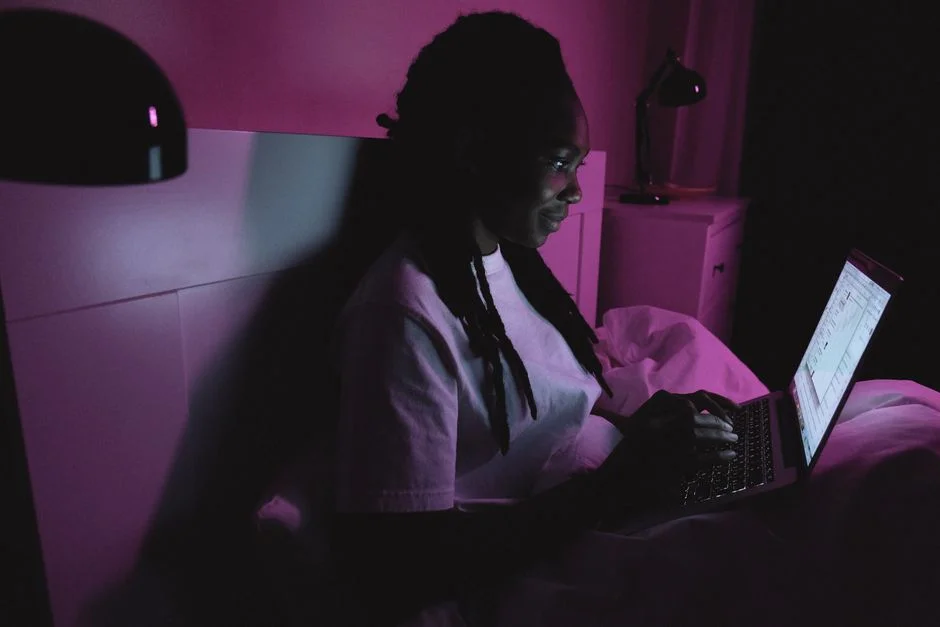
The cost of screen use usually gets described in mental terms – fragmented attention, shallow processing, distraction. Those are real, but there may be a more basic layer worth considering: sensory cost. One way to frame it is through the orienting reflex, an ancient response that directs attention to new or changing things in your surroundings. This post uses that reflex as a lens for thinking about screens. It’s a framing, not a measured finding. [OPINION]
The orienting reflex was studied in detail by the Soviet physiologist Evgeny Sokolov. It is a response to novel or changing stimuli, and it fades with repetition: when the same stimulus keeps arriving unchanged, the response weakens [1]. This reflex is useful for survival: it’s why you notice a branch move in the forest. But a digital environment, where notifications, animations, and video keep changing what’s on screen, is close to the opposite of a repeated, unchanging stimulus. It seems reasonable to expect that this kind of environment gives the reflex little chance to settle, though that inference isn’t something Sokolov’s work tested. [OPINION]
The most commonly recommended fix is blue-light-blocking glasses, and the evidence for them is weak. A 2023 Cochrane review of 17 randomized trials concluded that blue-light-filtering lenses may not reduce eye-strain symptoms from computer use over short follow-up, and that effects on sleep quality were indeterminate, with mixed results across trials [2]. That doesn’t mean screen light is irrelevant to sleep. In a controlled experiment, people who read on a light-emitting device before bed took longer to fall asleep, had reduced melatonin secretion, and showed a later circadian clock than when they read a printed book [3]. Together these point to a simple takeaway: a pair of glasses is not a substitute for changing when and how you use screens.
What may help instead is sensory rest: stretches of low-change visual input. The easiest version is time outdoors with your eyes on the horizon – no phone, no book, no podcast. A horizon offers almost nothing new to evaluate, which is the point. This is a practical suggestion drawn from the ideas below, not a protocol tested in trials. [OPINION]
Part of the reasoning comes from Attention Restoration Theory, which proposes that directed attention (the kind screen work demands) can become fatigued, and that recovery comes from experiences that engage a more effortless kind of attention, which natural settings tend to offer [4]. Natural environments are “softly interesting” – they hold your attention without demanding it. Experimental work supports a version of this: in two experiments, walking in nature or viewing pictures of nature improved performance on directed-attention tasks (a backwards digit-span task and the Attention Network Task) [5]. Those studies compared nature with urban settings, not with screens, and they didn’t test horizon-gazing specifically.
On dose, one study of 36 urban dwellers who spent time outdoors in places that gave a sense of contact with nature found that the drop in salivary cortisol per minute spent was greatest between 20 and 30 minutes, after which benefits continued at a reduced rate [6]. It was a small field study, and it measured stress hormones, not screen fatigue or the orienting reflex. It does give a sensible starting length, so a Bettering Me suggestion is 20 minutes outdoors with your eyes on distant objects, at whatever time of day you can manage. [OPINION]
If one session works for you, a second in the afternoon, when screen fatigue tends to be worst for many people, is an easy addition. It costs nothing. The only barrier is the urge to fill every gap with more input. [OPINION]
The pushback is almost always the same: “I don’t have time for two twenty-minute breaks.” Thinking of it as a break may miss the point. It’s maintenance. The same way you wouldn’t run a car engine at full throttle all day without letting it cool, it makes sense to build in stretches where your eyes and attention have nothing to chase. [OPINION]
References
↑︎ Sokolov EN. Higher nervous functions: the orienting reflex. Annu Rev Physiol. 1963;25:545-580. DOI: https://doi.org/10.1146/annurev.ph.25.030163.002553
↑︎ Singh S, Keller PR, Busija L, et al. Blue-light filtering spectacle lenses for visual performance, sleep, and macular health in adults. Cochrane Database Syst Rev. 2023;(8):CD013244. DOI: https://doi.org/10.1002/14651858.CD013244.pub2
↑︎ Chang AM, Aeschbach D, Duffy JF, Czeisler CA. Evening use of light-emitting eReaders negatively affects sleep, circadian timing, and next-morning alertness. Proc Natl Acad Sci U S A. 2015;112(4):1232-1237. DOI: https://doi.org/10.1073/pnas.1418490112
↑︎ Kaplan S. The restorative benefits of nature: toward an integrative framework. J Environ Psychol. 1995;15(3):169-182. DOI: https://doi.org/10.1016/0272-4944(95)90001-2
↑︎ Berman MG, Jonides J, Kaplan S. The cognitive benefits of interacting with nature. Psychol Sci. 2008;19(12):1207-1212. DOI: https://doi.org/10.1111/j.1467-9280.2008.02225.x
↑︎ Hunter MR, Gillespie BW, Chen SY. Urban nature experiences reduce stress in the context of daily life based on salivary biomarkers. Front Psychol. 2019;10:722. DOI: https://doi.org/10.3389/fpsyg.2019.00722

Kurt Greiner
Kurt is a digital strategist and IT professional blending emerging technology with practical application to help businesses and individuals streamline their digital presence. His current work focuses on the intersection of intentional living and technological resilience, exploring how individuals can leverage modern tools to navigate the second half of life with purpose.
Leave a Reply