
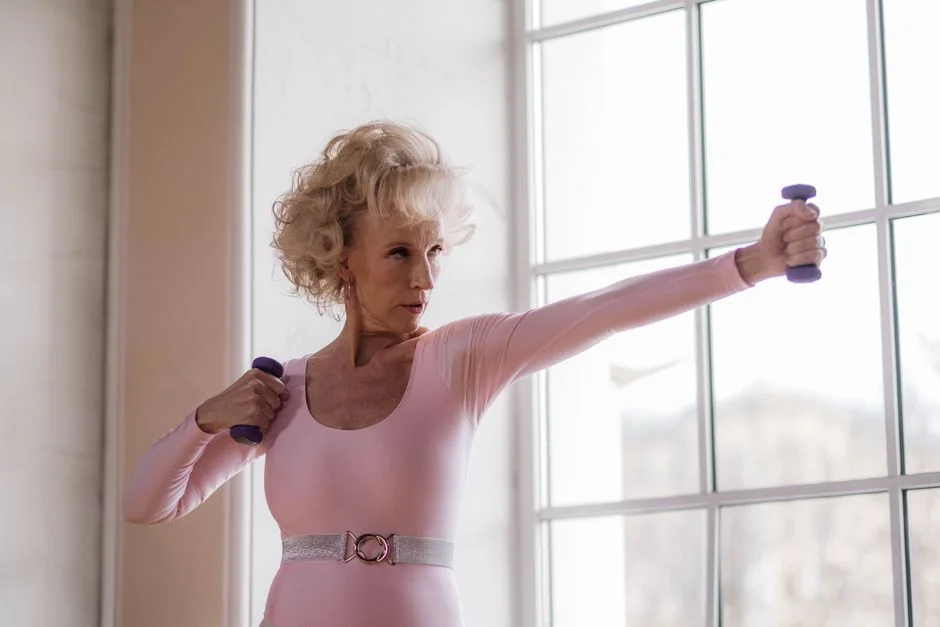
Belly fat around menopause is partly a shift in where your body stores fat and how much muscle it keeps, not just a rising number on the scale. The best-supported move in the trials is exercise, with strength work to protect muscle.
What the scale hides
The SWAN study followed women through the transition and measured body composition with scans. At the start of the transition, the rate of fat gain doubled and lean mass began to fall, and those shifts continued until about two years after the final period. Total weight, meanwhile, rose steadily without speeding up.[1] So the scale understates what is happening: weight climbs at the same pace while you gain fat faster and lose muscle.
What research links to fat at your middle
A review of the research found that weight gain itself cannot be attributed to the menopause transition. The change in hormones is linked to more total body fat and more abdominal fat, though. An older review also noted that estrogen therapy may partly offset that shift.[2] Visceral fat is the kind packed deep around the organs. Waist circumference is the measure the studies below tracked, and you can track it at home too.
Hot flashes, sleep and your waistline
In a study of 2,361 women, those whose hot flashes and night sweats became more frequent gained more weight afterward. Ten years of frequent symptoms was linked to a waist 3.0 cm larger. Poor sleep accounted statistically for no more than 27% of that waist change.[3] This is an association, not proof of cause, and the study did not test whether treating symptoms or improving sleep changes your waist. It does suggest that symptoms and sleep are worth raising with your clinician if your waist is changing.
What helps, according to the trials
A meta-analysis of 101 studies and 5,697 postmenopausal women found that exercise training increased muscle and reduced fat mass, body fat percentage, waist circumference and visceral fat. Aerobic training did more for fat, resistance training did more for muscle, and combining the two is a sound plan.[4]
- Check first if needed. If you have a heart condition or joint problems, or have been inactive, talk with your clinician before starting.
- Lift 2 to 3 times a week (a workable starting dose). Use loads heavy enough that the last two reps are hard. See How to Build Muscle Reserve in Your 40s for a starting plan.
- Add aerobic work you will keep doing. Brisk walks, cycling or swimming, 2 to 3 sessions a week.
- Judge progress by waist and strength. Measure your waist at the navel once a month and log the weights you lift, not just the scale.
- Protect sleep. If night sweats wreck your nights, bring that up with your clinician.
Where hormone therapy fits
Hormone therapy is not prescribed for weight. It is used for bothersome hot flashes and bone loss, it carries risks as well as benefits, and whether it suits you depends on your history, so that is a conversation for your clinician.[5] Our guide to HRT and TRT covers what the evidence supports. Fast or unexplained weight change is worth raising with your clinician.
If you want the full symptom picture first, start with Signs of Menopause at 50.
References
↑︎ Greendale GA, Sternfeld B, Huang M, et al. Changes in body composition and weight during the menopause transition. JCI Insight. 2019;4(5):e124865. DOI: https://doi.org/10.1172/jci.insight.124865. Finding used: in the SWAN cohort, at the start of the menopause transition the rate of fat gain doubled and lean mass declined, with changes continuing until about 2 years after the final period; weight itself climbed linearly with no acceleration at the transition.
↑︎ Davis SR, Castelo-Branco C, Chedraui P, et al. Understanding weight gain at menopause. Climacteric. 2012;15(5):419-429. DOI: https://doi.org/10.3109/13697137.2012.707385. Finding used: weight gain per se cannot be attributed to the menopause transition, but the change in hormones is associated with an increase in total body fat and abdominal fat; estrogen therapy may partly prevent this change in body composition.
↑︎ Gibson CJ, Shiozawa A, Epstein AJ, et al. Association between vasomotor symptom frequency and weight gain in the Study of Women’s Health Across the Nation. Menopause. 2023;30(7):709-716. DOI: https://doi.org/10.1097/GME.0000000000002198. Finding used: in 2,361 women, higher hot flash and night sweat frequency was associated with later increases in weight, BMI and waist circumference; ten years of frequent symptoms was associated with a 3.0-cm larger waist; sleep problems mediated no more than 27% of the waist increase.
↑︎ Khalafi M, Habibi Maleki A, Symonds ME, et al. The effects of exercise training on body composition in postmenopausal women: a systematic review and meta-analysis. Front Endocrinol (Lausanne). 2023;14:1183765. DOI: https://doi.org/10.3389/fendo.2023.1183765. Finding used: across 101 studies with 5,697 postmenopausal women, exercise training increased muscle mass and decreased fat mass, body fat percentage, waist circumference and visceral fat; aerobic training had the larger effect on fat, resistance training on muscle, and combined training is a viable strategy.
↑︎ The 2022 hormone therapy position statement of The North American Menopause Society. Menopause. 2022;29(7):767-794. DOI: https://doi.org/10.1097/GME.0000000000002028. Finding used: hormone therapy is the most effective treatment for vasomotor symptoms and the genitourinary syndrome of menopause and prevents bone loss; for women younger than 60 or within 10 years of menopause onset without contraindications, the benefit-risk ratio is favorable for bothersome vasomotor symptoms and prevention of bone loss; treatment should be individualized.

Kurt Greiner
Kurt is a digital strategist and IT professional blending emerging technology with practical application, exploring how individuals can leverage modern tools to navigate the second half of life with purpose.
Leave a Reply