
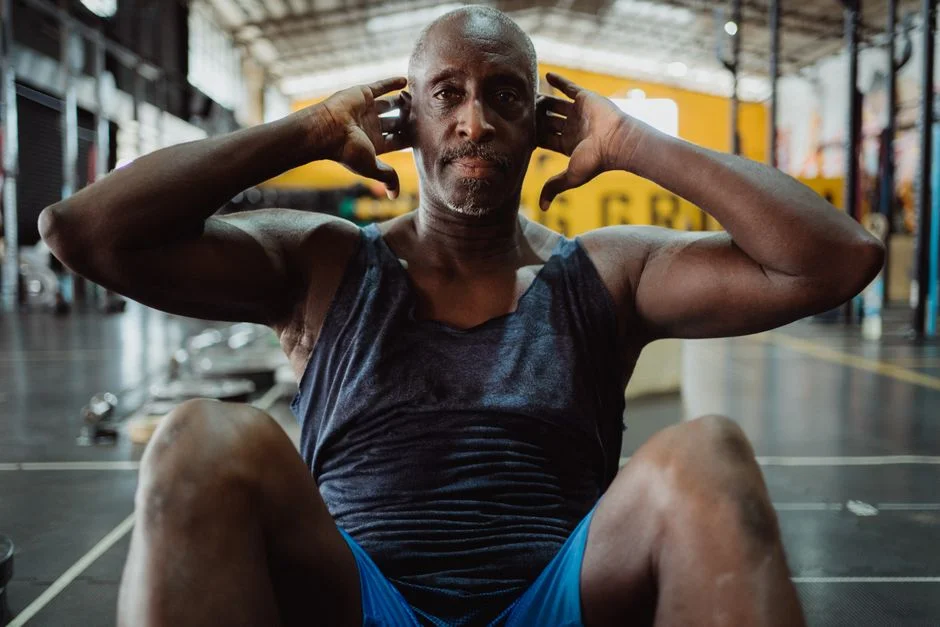
The muscle loss that determines your quality of life at 80 isn’t the dramatic wasting you picture with nursing homes and walkers. It’s slower and easier to miss. In the Health ABC study, which followed 1,880 older adults for three years, leg lean mass fell by roughly 1% a year, while leg strength fell 2.6-4.1% a year depending on sex and race – about three times faster.[1] A bathroom scale shows neither change.
That gap matters for how you train. In the same study, gaining lean mass was not accompanied by maintaining or gaining strength, which the authors read as a decline in muscle quality.[1] Strength is what you notice first when function slips: trouble getting out of a low chair, walking slower, losing your balance on uneven ground. The encouraging part is that resistance training moves those measures. A Cochrane review of 121 trials with 6,700 older participants found a large positive effect on muscle strength, a moderate to large effect on getting out of a chair, and a modest improvement in gait speed.[2] The trials were in older adults, so for people in their 40s this is a reason to build strength now, not a measured prevention result.
The fix has nothing to do with how you look. Bettering Me’s baseline for midlife is two full-body resistance sessions a week. The WHO recommends muscle-strengthening activities at moderate or greater intensity, involving all major muscle groups, on two or more days a week.[3] In a meta-analysis of cohort studies, the largest risk reductions for all-cause mortality, cardiovascular disease and cancer showed up at about 30-60 minutes a week of muscle-strengthening activity.[4] This is a baseline built from those sources, not a proven minimum for 40-year-olds. It’s the amount that fits what the research supports while staying easy to keep up.
What does “enough load” actually feel like? The American College of Sports Medicine recommends loads in the 8-12 repetition-maximum range for people newer to lifting – a weight you can lift 8-12 times, with the last couple of reps genuinely hard. If you can finish a set and immediately chat comfortably, the weight is probably too light. The same position stand recommends a 2-10% increase in load once you can do one or two more reps than planned at the current weight, so adding a little weight every few weeks as it gets manageable is the right pattern.[5]
On protein, a conference-based review concluded that intakes of at least 1.2 to 1.6 g per kilogram of body weight per day of high-quality protein are a more ideal target than the current Recommended Dietary Allowance for adults.[6] In a meta-analysis of 49 trials, protein supplementation beyond total intakes of about 1.6 g/kg a day produced no further gains in lean mass from resistance training in healthy adults.[7] Bettering Me’s target of 1.6 g/kg is the top of that range. That figure is the breakpoint from supplementation trials in healthy adults, so it is a practical target, not a proven ceiling for people in their 40s. Spreading it across meals may also matter more with age: in a pooled analysis of men, muscle protein synthesis plateaued at roughly 0.40 g/kg of protein per meal in older men (average age about 71) versus 0.24 g/kg in younger men (average age about 22); the body-mass difference was borderline (p = .055).[8] These single-meal data suggest older adults may need more protein per sitting. If you have kidney disease, check with your clinician before raising your protein intake.
Walking is the third piece. In a meta-analysis of 15 cohorts with 47,471 adults, more daily steps were associated with a lower risk of death from any cause, with the benefit levelling off around 6,000-8,000 steps a day in adults 60 and older and around 8,000-10,000 steps a day in adults under 60.[9] That is an association from observational data, and it covers mortality, not bone density or fall prevention. Steps don’t replace lifting, and nothing in these sources says they do. Eight thousand steps sits at the low end of where the benefit levels off for adults under 60.
This isn’t a full plan. It’s the baseline. It’s enough to start from, and you can add to it once it feels routine.
Counterpoint: can you still build muscle after 50? Yes – but the effort-to-gain ratio changes. “Anabolic resistance” – a weaker muscle-building response to protein intake – increases with age.[10] The per-meal protein figures above show the same thing from the other direction: older men needed a larger relative dose to reach the same response. The Cochrane evidence shows that older adults gain strength with resistance training.[2] Whether training in your 40s builds a reserve that pays off in your 60s is a reasonable bet, but none of these studies tested it directly.
The three things that get in the way of this plan aren’t knowledge, time, or money. They’re the belief that “something” is as good as “enough,” confusing how you look with what you’re actually preserving, and assuming you’ll notice the loss before it becomes a real problem. In this plan, “enough” is a specific number – two sessions, 1.6 g/kg of protein, 8,000 steps. The numbers give you a target to measure against.
Bettering Me’s recommendation: two sessions, 1.6 g/kg, and 8,000 steps. That’s the baseline. Everything else is optional.
A sample week. Monday: resistance training (squat, bench press, row – 3 sets of 8-10 reps each). Wednesday: resistance training (deadlift, overhead press, pull-up or lat pulldown, farmer carry – 3 sets of 8-10 reps each). Every day: 8,000+ steps, built up through walking meetings, parking farther away, after-dinner walks, or a dedicated 20-25 minute walk. Protein: spread across three or four meals through the day. That’s it. No split routines, no special equipment beyond a barbell or dumbbells and a rack, no periodization plan, no tracking beyond a simple training log. Consistency matters more than precision here. If you are sedentary, are new to lifting, or have joint, heart, or blood-pressure problems, check with a clinician before starting heavy lifts such as deadlifts, overhead presses, and pull-ups, and consider learning the form with a qualified coach. The Cochrane review notes that adverse events were poorly recorded and that some caution is needed.[2]
What failure usually looks like. Two mistakes are easy to make. One is doing too much and burning out. The other is lifting too light. People confuse “tired from exercising” with “actually stressed the muscle enough.” If you finish a resistance session feeling tired but not challenged on the last two reps of each set, the weight is probably too light. If you’re not struggling on those last two reps, that’s a useful thing to notice and fix, not a reason to be hard on yourself.
References
↑︎ Goodpaster BH, Park SW, Harris TB, et al. The loss of skeletal muscle strength, mass, and quality in older adults: the Health, Aging and Body Composition Study. J Gerontol A Biol Sci Med Sci. 2006;61(10):1059-1064. DOI: https://doi.org/10.1093/gerona/61.10.1059
↑︎ Liu CJ, Latham NK. Progressive resistance strength training for improving physical function in older adults. Cochrane Database Syst Rev. 2009;(3):CD002759. DOI: https://doi.org/10.1002/14651858.CD002759.pub2
↑︎ Bull FC, Al-Ansari SS, Biddle S, et al. World Health Organization 2020 guidelines on physical activity and sedentary behaviour. Br J Sports Med. 2020;54(24):1451-1462. DOI: https://doi.org/10.1136/bjsports-2020-102955
↑︎ Momma H, Kawakami R, Honda T, Sawada SS. Muscle-strengthening activities are associated with lower risk and mortality in major non-communicable diseases: a systematic review and meta-analysis of cohort studies. Br J Sports Med. 2022;56(13):755-763. DOI: https://doi.org/10.1136/bjsports-2021-105061
↑︎ American College of Sports Medicine. American College of Sports Medicine position stand. Progression models in resistance training for healthy adults. Med Sci Sports Exerc. 2009;41(3):687-708. DOI: https://doi.org/10.1249/MSS.0b013e3181915670
↑︎ Phillips SM, Chevalier S, Leidy HJ. Protein "requirements" beyond the RDA: implications for optimizing health. Appl Physiol Nutr Metab. 2016;41(5):565-572. DOI: https://doi.org/10.1139/apnm-2015-0550
↑︎ Morton RW, Murphy KT, McKellar SR, et al. A systematic review, meta-analysis and meta-regression of the effect of protein supplementation on resistance training-induced gains in muscle mass and strength in healthy adults. Br J Sports Med. 2018;52(6):376-384. DOI: https://doi.org/10.1136/bjsports-2017-097608
↑︎ Moore DR, Churchward-Venne TA, Witard O, et al. Protein ingestion to stimulate myofibrillar protein synthesis requires greater relative protein intakes in healthy older versus younger men. J Gerontol A Biol Sci Med Sci. 2015;70(1):57-62. DOI: https://doi.org/10.1093/gerona/glu103
↑︎ Paluch AE, Bajpai S, Bassett DR, et al. Daily steps and all-cause mortality: a meta-analysis of 15 international cohorts. Lancet Public Health. 2022;7(3):e219-e228. DOI: https://doi.org/10.1016/S2468-2667(21)00302-9
↑︎ Burd NA, Gorissen SH, van Loon LJ. Anabolic resistance of muscle protein synthesis with aging. Exerc Sport Sci Rev. 2013;41(3):169-173. DOI: https://doi.org/10.1097/JES.0b013e318292f3d5

Kurt Greiner
Kurt is a digital strategist and IT professional blending emerging technology with practical application to help businesses and individuals streamline their digital presence. His current work focuses on the intersection of intentional living and technological resilience, exploring how individuals can leverage modern tools to navigate the second half of life with purpose.
Leave a Reply