
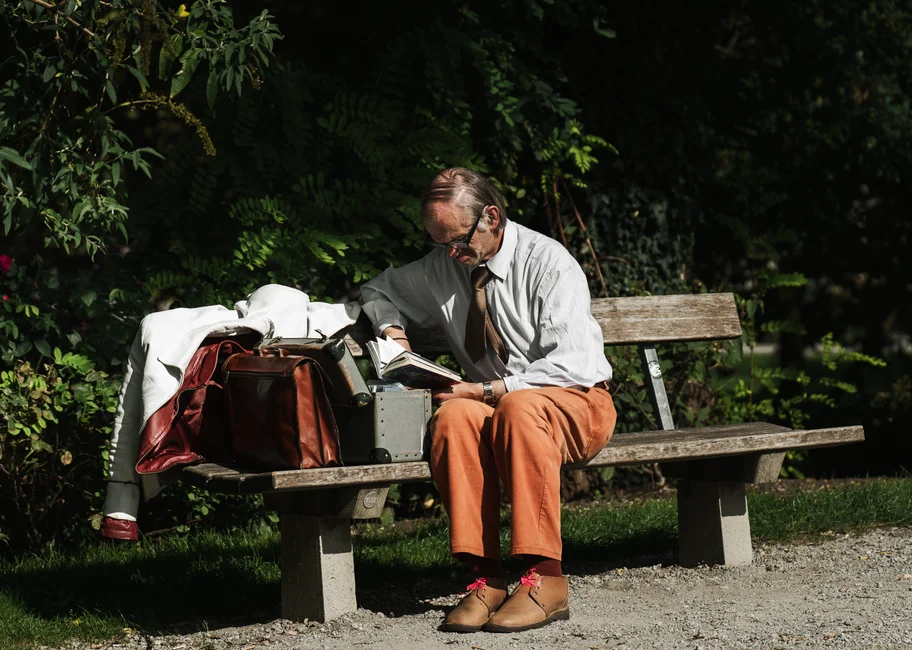
A 2026 study followed 87,577 adults from the UK Biobank, a large research database, and found that people who got more bright daytime light were associated with lower dementia risk over about eight years. Light was measured with a wrist-worn sensor, the design is observational, and the effect is modest. It is a useful signal, not proof that daylight protects the brain.[1]
What the study measured
Participants did not have dementia at the start. Their average age was 62, and about 57 percent were women. Each person wore a wrist accelerometer for seven days, which recorded light levels during the day and at night. Over a median follow-up of 8.1 years, 741 people developed dementia. The analyses adjusted for factors including age, sex, physical activity, diet, obesity, diabetes, blood pressure and hearing loss.
Because researchers observed what happened rather than assigning anyone more or less light, the study can show an observational association. It cannot show that light caused the difference.
What it found
- Average daytime light above 1,000 lux: hazard ratio 0.84 (95% confidence interval 0.71 to 0.99) in the fully adjusted model. A simpler model adjusted only for age and sex did not reach statistical significance.[1]
- Bright light at 5,000 lux or more for at least 0.70 hours a day: hazard ratio 0.83 (95% CI 0.70 to 0.99) in the fully adjusted model.
- Nighttime light: no association. Hazard ratios across nighttime quartiles ranged from 0.96 to 1.02.
A hazard ratio below 1 means lower risk in the group with more daytime light, compared with people below the threshold. An HR of 0.83 describes that gap. It is not a percentage increase in risk for people who get less light.
The limits of this study
The study has real limits, and they matter for how much weight to give it:
- Other differences may explain the link. People who spend more time in daylight may differ from those who spend less in ways the study did not capture.
- Reverse causation is possible. Early changes in the brain can reduce time outdoors, so some of the pattern could run the other way. The design cannot fully rule this out.
- The cutoffs came from the same data. The 1,000 lux and 0.70-hour thresholds were picked from exploratory analyses of this dataset. The specific numbers may not hold up in new data.
- Wrist, not eye. A wrist sensor is a coarse estimate of the light that reaches your eyes. It also cannot tell darkness from a covered sensor.
- Seven days is short. A week of measurement may not reflect long-term habits.
- A healthier-than-average group. UK Biobank volunteers are healthier and less socioeconomically deprived than the general population. The authors say their thresholds may not transfer directly.
- Fragile in a sensitivity analysis. When daytime was defined by sunrise and sunset instead, the associations weakened slightly and no longer reached statistical significance.
- Single-cohort evidence. The study had 741 dementia cases, wide confidence intervals and no independent replication. Light was recorded from 2014 to 2018, before widespread LED lighting and nighttime device use.
Exploratory findings
Subgroup analyses that the authors label as exploratory suggested stronger associations in people with an evening chronotype (a late-running body clock) and in carriers of the APOE e4 gene variant. Some of these subgroup results showed risk reductions of up to 41%. Treat them as questions for future research, not as guidance for anyone in particular.
What to take from it
Daylight is free and easy to get. What this study does not show is that a specific amount of light prevents dementia, or that bright light treats it. The authors call for more research on whether light could play a role in screening and whether light-based interventions could be developed.
- Take a 20-minute walk outside at lunch when your schedule allows.
- If you are worried about memory changes, talk with a clinician. Daylight is not a substitute for an evaluation.
References
[1] Zheng N, Wang W, Li B, et al. “Associations between wearable-device-measured daytime and nighttime light exposures and dementia risk: A prospective cohort study.” General Psychiatry. 2026;39(3):e70039. DOI: 10.1002/gps3.70039. Finding as used: in 87,577 dementia-free UK Biobank adults followed for a median of 8.1 years (741 dementia cases), average daytime light above 1,000 lux was associated with lower dementia hazard (HR 0.84, 95% CI 0.71–0.99, fully adjusted); bright light at 5,000 lux or more for at least 0.70 h per day was associated with HR 0.83 (95% CI 0.70–0.99); nighttime light was not associated. Observational design. ↑︎ a b

Kurt Greiner
Kurt is a digital strategist and IT professional blending emerging technology with practical application, exploring how individuals can leverage modern tools to navigate the second half of life with purpose.
Leave a Reply