
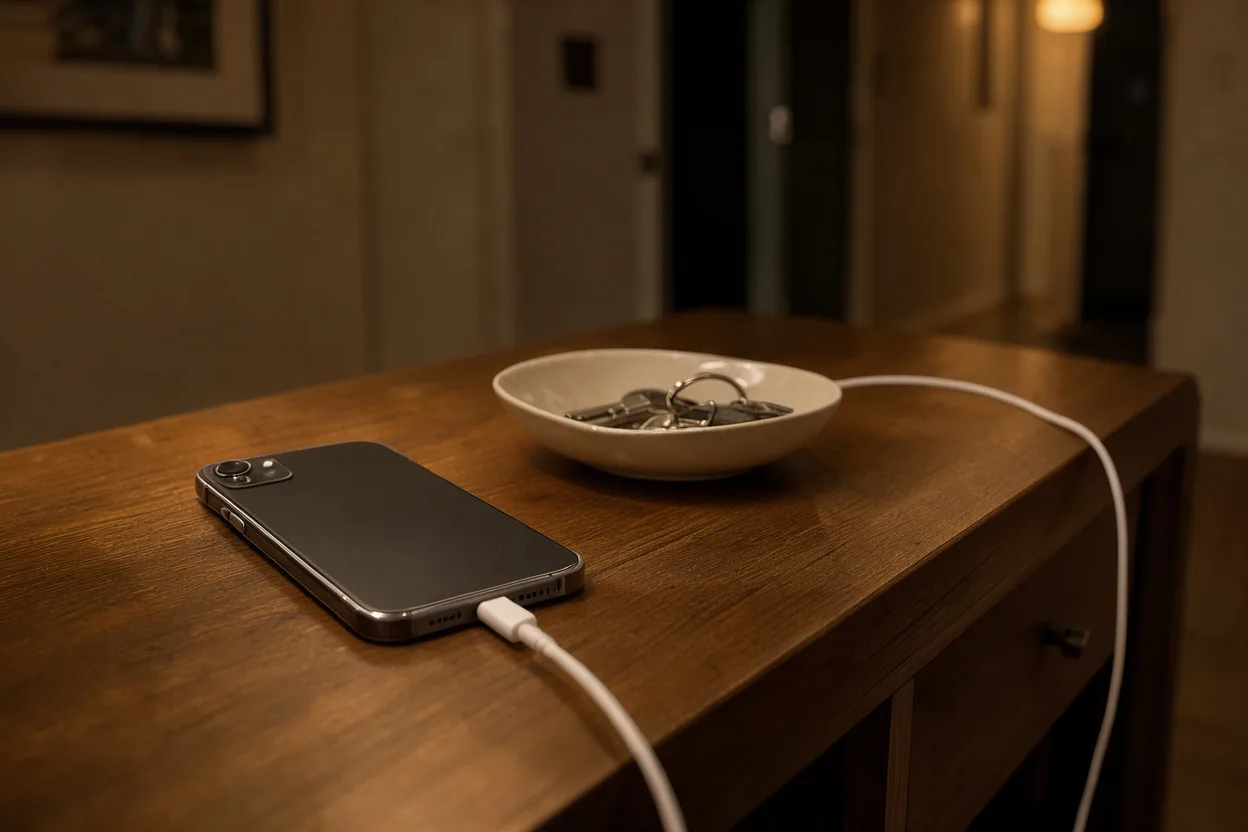
If you check your phone one last time at night and again before you sit up in the morning, there is a simple experiment you can run: give the phone its own spot outside the bedroom for two weeks and see what changes. One health writer did exactly that and reported better sleep and calmer mornings. It is one person’s account, not a trial, but the idea is cheap, free and easy to test on yourself.
What the experiment was
A writer at Prevention kept waking around 3 a.m. with a racing mind. She had already tried screen-time limits on email and social apps, but they were easy to skip with an “ignore for 15 minutes” tap. So for 14 nights she moved the phone to a charging spot in the living room between 9 and 9:30 p.m., and it stayed there until morning.
She reported a short stretch of “separation anxiety” at first, then easier sleep onset, fewer wake-ups, and mornings that started with less email and scrolling in bed. Her own summary: she felt calmer about her workload. That is a self-report from a single person with no comparison period, so treat it as a story worth borrowing from, not as proof. Your experience may differ, and what worked for one person may not work for you.
Why moving the phone may work
The sleep psychologist quoted in the article, Natalie Dautovich of Virginia Commonwealth University, points to a few mechanisms. A last scroll can easily become an hour. What you read can wake up your emotions. Notifications can wake you. And if the phone is always at the bedside, the bed starts to be associated with whatever the phone brings up.
Her most practical point is about friction. When the phone is in another room, using it takes a deliberate decision to get up and go get it. Screen-time limits you can override with one tap do not add that friction.
What the research says, and what it does not
In 2024 the National Sleep Foundation convened a 16-person expert panel to review the experimental evidence on screens and sleep. The panel reached consensus that screen use in general, and the content of screen use before sleep, impair sleep health in children and adolescents, and that behavioral strategies may reduce those negative effects.[1]
Two limits matter here. The consensus statements in that report are about children and adolescents, so they do not prove the same effect in adults. And “may reduce” is the panel’s wording for behavioral strategies, not a guarantee. Nothing here shows that docking your phone will ease early-morning anxiety specifically.
How to try it for two weeks
- Pick a docking spot outside the bedroom with a charger, and set it up before the first night.
- Tie the hand-off to something you already do every night, such as washing your face or brushing your teeth.
- Replace the scroll with something calm. Dautovich suggests a low-stimulation paper book, and notes that emotionally charged material can wake you up.
- If you wake with anxious thoughts, try a scheduled “worry time” of 15 to 30 minutes earlier in the evening to write down what is on your mind, so those loops are already closed.
- If you rely on the phone as an alarm, buy a cheap alarm clock first so the phone has no reason to come back to the bedside.
Keep a simple note each morning: how long it took to fall asleep, how many times you woke, and how anxious you felt on a scale of 1 to 10. After two weeks you will have your own data.
When to talk to someone
Waking at 3 a.m. now and then is common. If early-morning anxiety or poor sleep keeps showing up for weeks, or it is getting in the way of work, relationships or daily life, talk to a clinician. A phone dock is a habit, not a treatment, and persistent anxiety or insomnia deserves a proper look. If you are ever in crisis, call or text 988 (US) to reach the Suicide and Crisis Lifeline.
References
↑︎ Hartstein LE, Mathew GM, Reichenberger DA, et al. The impact of screen use on sleep health across the lifespan: A National Sleep Foundation consensus statement. Sleep Health. 2024. Population: 16-person expert panel using a modified Delphi RAND/UCLA method; literature review of 35 experimental and intervention studies plus 5 systematic reviews. DOI: https://doi.org/10.1016/j.sleh.2024.05.001. Finding as used: the panel reached consensus that screen use in general impairs sleep health in children and adolescents, that pre-sleep screen content impairs sleep health in children and adolescents, and that behavioral strategies and interventions may attenuate the negative effects of screen use on sleep health; consensus was reached on 5 of 10 candidate statements.

Kurt Greiner
Kurt is a digital strategist and IT professional blending emerging technology with practical application, exploring how individuals can leverage modern tools to navigate the second half of life with purpose.
Leave a Reply