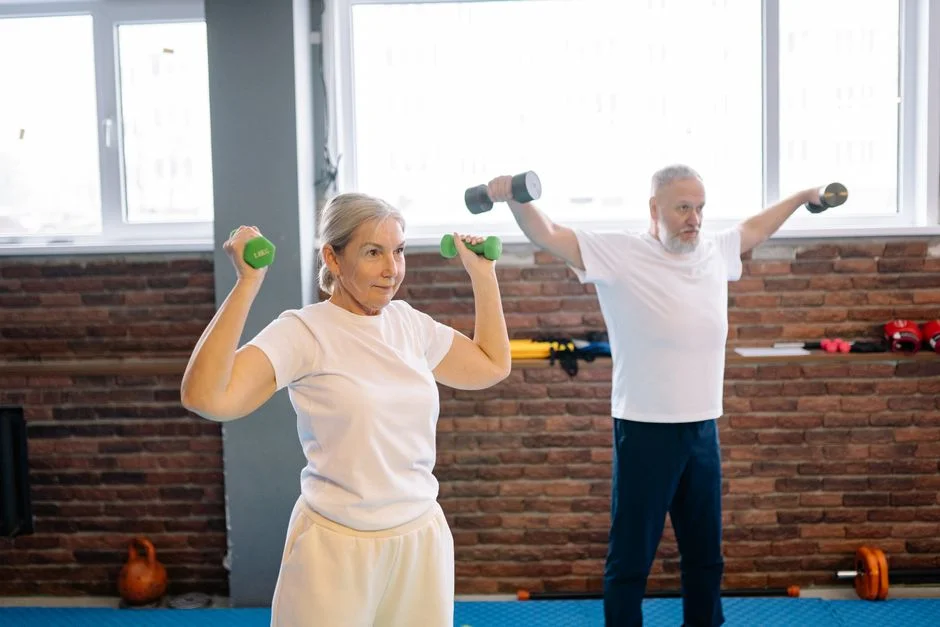
Two large cohort studies link muscle strength and muscle mass to how long people live. In the UK Biobank study of 502,293 adults aged 40-69, each 5 kg lower grip strength was associated with a 16% higher hazard of dying from any cause in men and a 20% higher hazard in women, over a mean follow-up of 7.1 years [1]. In a separate US analysis of 3,659 older adults, those in the highest quarter for muscle mass index had about 20% lower all-cause mortality than those in the lowest quarter, after adjusting for central obesity and other factors (adjusted risk ratio 0.81, hazard ratio 0.80) [2]. Both studies are observational, so they show associations, not proof that building muscle extends life. A reasonable reading is that muscle works like a canary in a coal mine for overall health – and that it also does real work for you in daily life. [OPINION]
Whatever the exact link to survival, muscle plausibly sets the floor for everyday function: standing up from a chair, carrying groceries, or climbing stairs. When strength falls far enough, those tasks become exhausting or impossible, and independence in older age plausibly depends on that. Neither cohort above measured independence or disability; their outcome was death. [OPINION]
There’s an important difference between sarcopenia and dynapenia. Sarcopenia was traditionally defined as the loss of muscle mass. Dynapenia is the age-associated loss of muscle strength and power. Clark and Manini argued that the loss of strength is not explained by the loss of mass alone, and proposed that changes in contractile properties and neurologic function also play a role [3]. The 2019 European consensus on sarcopenia took a step in that direction: it focuses on low muscle strength as the key characteristic, uses low muscle quantity or quality to confirm the diagnosis, and treats poor physical performance as a sign of severe sarcopenia [4]. In practice, that makes functional tests – chair stands, walking speed, grip strength – a useful part of tracking, not just a scan.
Anabolic resistance is one reason preserving muscle in midlife is worth prioritizing now rather than later. Aging has been associated with a reduced muscle protein synthetic response to protein intake, a pattern called anabolic resistance, and the level of habitual physical activity may be fundamental to maintaining that responsiveness [5]. In one analysis, muscle protein synthesis in healthy older men (about 71 years) plateaued at a per-meal intake of roughly 0.40 g of protein per kg of body mass, versus roughly 0.24 g/kg in younger men (about 22 years) [6]. The older-versus-younger difference on a per-body-mass basis was borderline (p = .055) in that study and the participants were men, so treat it as a signal that older adults may need more protein per meal, not as an exact rule. Staying consistently active over the years is the part you control. [OPINION]
The sarcopenia criteria set by the European Working Group on Sarcopenia in Older People offer a useful reference point, even for prevention. Its cut-off points are low grip strength (below 27 kg for men, below 16 kg for women), low appendicular muscle mass relative to height (ASM/height² below 7.0 kg/m² for men, below 5.5 kg/m² for women), and a gait speed of 0.8 m/s or slower, which the group uses as an indicator of severe sarcopenia [4]. These are clinical thresholds designed for older adults. You don’t want to approach them in your 60s, which is one reason to treat your 40s and 50s as a building window. [OPINION]
Bettering Me’s protocol for preserving muscle starts with an optional step: a DEXA scan as a baseline for your lean mass, fat mass, and bone density, repeated every two years to track your trend. That is one option, not a guideline (see the DEXA note below). Then do two resistance-training sessions a week on compound movements at a challenging, high intensity. A Cochrane review of 121 trials in older people found that progressive resistance training, mostly done two to three times per week at high intensity, improved muscle strength, gait speed, and the ability to get out of a chair [7]. That review also notes that adverse events were poorly recorded and that some caution is needed, so if you are sedentary or have heart, joint, or blood-pressure problems, check with a clinician before starting high-intensity lifting [7]. For protein, aim for roughly 1.6 grams per kilogram of body weight per day, split across your meals. A meta-analysis of resistance-training trials in healthy adults found that gains in fat-free mass stopped rising beyond about 1.62 g/kg/day of total protein, and that the benefit of protein supplementation was smaller with increasing age [8]. If you have kidney disease or another medical condition, check your protein target with your clinician first. Measure grip strength once a year as a check, and if it falls between measurements, review your training and protein. [OPINION]
Counterpoint: what about bodybuilders who die young? That’s a fair question. The studies cited here measured grip strength and muscle mass in general adult populations, not competitive bodybuilders, so they can’t tell us how very large muscle mass, steroid use, or extreme dieting affect longevity. The findings apply to ordinary people building and keeping strength, not to competition-level physiques.
Muscle isn’t just about how you look. It’s one of the tissues that supports standing, walking, carrying groceries, traveling on your own, and living in your own home at 80. Treat it like infrastructure – something you build and maintain, because it’s easier to keep than to rebuild. [OPINION]
The DEXA scan protocol. A DEXA scan gives you total lean mass, fat mass, bone density, and a regional breakdown (arms, legs, trunk, and the ratio between upper and lower body fat). For tracking muscle, the number to watch is appendicular lean mass index (ALMI): the lean mass of your arms and legs divided by your height in meters, squared – the same ASM/height² measure used in the consensus criteria above [4]. If you choose to use it, get a baseline at 40, then repeat every two years, and look at the trend rather than a single number. This is one option, not a guideline: routine DEXA scanning in your 40s is not a guideline-recommended practice, the 2019 European consensus cited above does not recommend population DEXA screening, and scans involve a low radiation dose, a cost, and limited precision for detecting small changes in one person over two years. If the trend is heading down between scans, review your protein intake and training load. DEXA also measures bone density, and a meta-analysis of prospective studies in women found that lower bone density predicts later fractures (relative risk about 1.5 per standard deviation below the age-adjusted mean), although it cannot identify who will actually have a fracture [9]. The authors of that meta-analysis did not recommend a programme of screening menopausal women by measuring bone density. One scan gives you two useful data streams. [OPINION]
The stakes of a fall. Independence is what’s at risk when strength fails, and a hip fracture shows how steep that can get. A meta-analysis of prospective cohorts found that the relative hazard of death in the first three months after hip fracture was about 5.8 in women and 8.0 in men compared with peers of the same age and sex, and that the excess risk did not return to control levels over time [10]. That study didn’t test whether muscle training prevents fractures, so read it as context for why people care about strength, not as a promise. The training and protein steps above cost a gym routine and some planning, and what they buy is a better chance of staying independent. [OPINION]
References
↑︎ Celis-Morales CA, Welsh P, Lyall DM, et al. Associations of grip strength with cardiovascular, respiratory, and cancer outcomes and all cause mortality: prospective cohort study of half a million UK Biobank participants. BMJ. 2018;361:k1651. DOI: https://doi.org/10.1136/bmj.k1651
↑︎ Srikanthan P, Karlamangla AS. Muscle mass index as a predictor of longevity in older adults. Am J Med. 2014;127(6):547-553. DOI: https://doi.org/10.1016/j.amjmed.2014.02.007
↑︎ Clark BC, Manini TM. Sarcopenia =/= dynapenia. J Gerontol A Biol Sci Med Sci. 2008;63(8):829-834. DOI: https://doi.org/10.1093/gerona/63.8.829
↑︎ Cruz-Jentoft AJ, Bahat G, Bauer J, et al. Sarcopenia: revised European consensus on definition and diagnosis. Age Ageing. 2019;48(1):16-31. DOI: https://doi.org/10.1093/ageing/afy169
↑︎ Burd NA, Gorissen SH, van Loon LJ. Anabolic resistance of muscle protein synthesis with aging. Exerc Sport Sci Rev. 2013;41(3):169-173. DOI: https://doi.org/10.1097/JES.0b013e318292f3d5
↑︎ Moore DR, Churchward-Venne TA, Witard O, et al. Protein ingestion to stimulate myofibrillar protein synthesis requires greater relative protein intakes in healthy older versus younger men. J Gerontol A Biol Sci Med Sci. 2015;70(1):57-62. DOI: https://doi.org/10.1093/gerona/glu103
↑︎ Liu CJ, Latham NK. Progressive resistance strength training for improving physical function in older adults. Cochrane Database Syst Rev. 2009;(3):CD002759. DOI: https://doi.org/10.1002/14651858.CD002759.pub2
↑︎ Morton RW, Murphy KT, McKellar SR, et al. A systematic review, meta-analysis and meta-regression of the effect of protein supplementation on resistance training-induced gains in muscle mass and strength in healthy adults. Br J Sports Med. 2018;52(6):376-384. DOI: https://doi.org/10.1136/bjsports-2017-097608
↑︎ Marshall D, Johnell O, Wedel H. Meta-analysis of how well measures of bone mineral density predict occurrence of osteoporotic fractures. BMJ. 1996;312(7041):1254-1259. DOI: https://doi.org/10.1136/bmj.312.7041.1254
↑︎ Haentjens P, Magaziner J, Colón-Emeric CS, et al. Meta-analysis: excess mortality after hip fracture among older women and men. Ann Intern Med. 2010;152(6):380-390. DOI: https://doi.org/10.7326/0003-4819-152-6-201003160-00008

Kurt Greiner
Kurt is a digital strategist and IT professional blending emerging technology with practical application to help businesses and individuals streamline their digital presence. His current work focuses on the intersection of intentional living and technological resilience, exploring how individuals can leverage modern tools to navigate the second half of life with purpose.
Leave a Reply