
Across many studies, weaker grip strength has been associated with a higher risk of death from any cause. The UK Biobank study of nearly 500,000 people found that every 5 kg drop in grip strength was linked to a 16% higher risk of dying from any cause in men and a 20% higher risk in women, and that link held up even after accounting for age, weight, smoking, activity level, and income [1]. A 2010 meta-analysis that pooled 14 studies of grip strength (Cooper et al.) also found an association with all-cause mortality [2].
It’s easy to misread these results as saying that grip strength is itself protective – that having strong hands extends your life. The studies above describe an association and a prediction, not that.
Grip strength is best understood as a marker. Researchers think it reflects your overall muscle mass and the health of your nervous system’s connection to your muscles, though that is a hypothesis rather than something the studies above demonstrated. On that view, someone with a strong grip likely has good overall muscle mass and a nervous system that recruits muscle fibers efficiently, and the grip test is capturing the health of your whole motor system – the nerve pathways from your brain, how efficiently your muscles get activated, and the muscle mass that produces the force. Your hands are just a convenient place to measure it.
The neurological piece of this often gets overlooked. Grip strength depends on your brain’s ability to activate the right nerve cells, how well the signal travels down your spinal cord, how well that signal reaches the muscle, and how well the muscle fibers themselves can contract. A declining grip reading may reflect a decline in one or more of these systems, possibly before you notice any change in how you function. That is our reading rather than something the studies above tested, and a problem in the hand or a nerve can also lower grip, which is why unexplained loss deserves a clinician’s look (see below).
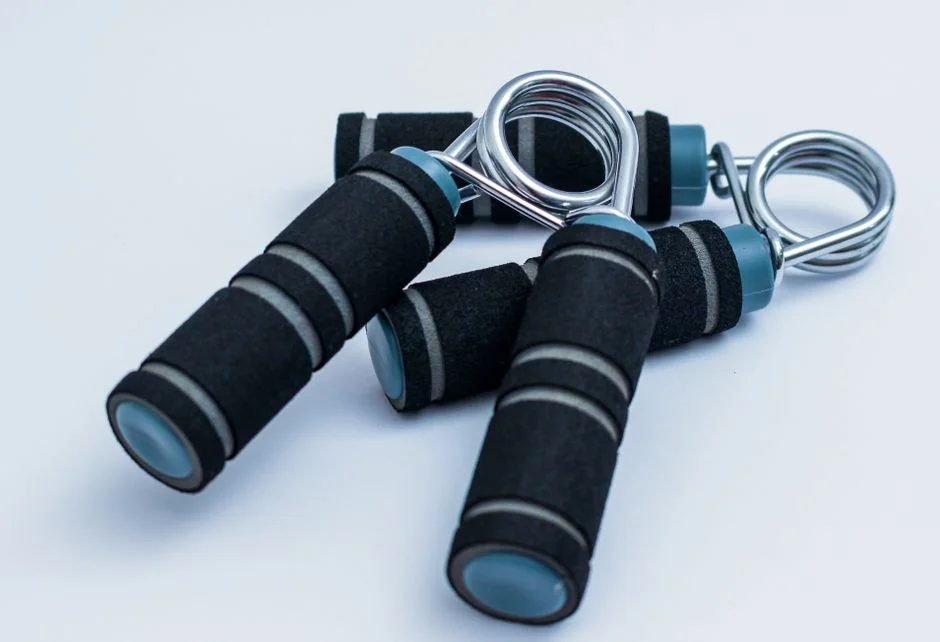
This suggests training your grip specifically – hand grippers, forearm curls, rock climbing, squeeze devices – may not improve your overall health in any direct way. That is our view, not a tested result. It improves your grip, and that improved grip would show up as a better number on the dynamometer, even though your overall muscle mass, nervous-system health, and metabolic reserve may not have changed at all. The measurement can improve without the thing it’s measuring actually improving.
This isn’t a criticism of grip strength as a test. It’s a caution about how to interpret it. Grip strength is an excellent screening test – cheap, fast, and repeatable. In our view, it’s a poor thing to train for directly. Training your grip to raise your grip-strength score is like raising your car’s oil pressure reading by tightening the oil cap. You changed the number. You didn’t change what the number is supposed to measure.
The real value of an annual grip test is as a check on your overall training. In our view, a grip strength that drops year over year may mean your overall training isn’t enough. Dynamometer readings also vary with effort, time of day, injury, and illness, so one lower reading isn’t a diagnosis. The test doesn’t need to be replaced. It just needs to be treated as a signal, not a goal.
What should you train instead? Functional tests that measure the same underlying thing more directly. The five-times-sit-to-stand test (how fast you can stand up from a chair five times without using your arms) captures lower-body strength, power, and coordination. In pooled data from nine cohorts of adults aged 65 and older, walking speed was associated with survival [4]. The Short Physical Performance Battery – which combines walking speed, chair stands, and balance – predicted self-reported disability, nursing home admission, and mortality in older adults [3].
Counterpoint: doesn’t grip training still build forearm muscle? Yes, locally. But grip training adds only a small amount to your total muscle mass. In our view, for the goal of extending healthy years, grip-specific training gives you a poor return on the time, effort, and equipment involved, compared to compound resistance training that targets the major muscle groups.
Bettering Me’s recommendation: track your grip strength once a year as a dashboard warning light. If it’s stable, your training may be adequate for maintenance. If it’s rising, your training may be producing results. If it’s declining, investigate – but we wouldn’t train your grip itself. If your grip drops quickly or without explanation, or comes with numbness, tingling, pain, or weakness elsewhere, see a clinician: it can signal a nerve compression, carpal tunnel, arthritis, or neuromuscular problem that needs evaluation, not just more training. Check how consistent your training actually is, check your protein intake, check your sleep, and if you want a direct measure of muscle mass, ask a clinician whether a DEXA scan makes sense for you (it is one option, not a guideline recommendation). The grip test is a warning light, not a part you fix directly. When the warning light comes on, don’t check the light. Check the engine.
The sit-to-stand alternative. Five chair stands (arms crossed over your chest), done as fast as you safely can, are a rough check on lower-body strength. We don’t have a verified cut-off to offer, so use the time to compare against your own earlier results rather than as a pass or fail, and mention it to a clinician if it is getting slower or the test feels hard. Do the test next to a sturdy surface, and check with a clinician first (or skip it) if you have balance problems, dizziness, or a history of falls. This test costs nothing, needs no equipment, and captures the thing that actually matters more directly than grip does – because it’s your legs, not your hands, that determine whether you can stand, walk, and climb stairs at 80.
References
↑︎ Celis-Morales CA, et al. "Associations of grip strength with cardiovascular, respiratory, and cancer outcomes and all cause mortality." *BMJ*. 2018;361:k1651. DOI: https://doi.org/10.1136/bmj.k1651
↑︎ Cooper R, et al. "Objectively measured physical capability levels and mortality: systematic review and meta-analysis." *BMJ*. 2010;341:c4467. DOI: https://doi.org/10.1136/bmj.c4467
↑︎ Guralnik JM, et al. "A short physical performance battery assessing lower extremity function: association with self-reported disability and prediction of mortality and nursing home admission." *J Gerontol*. 1994;49(2):M85-M94. DOI: https://doi.org/10.1093/geronj/49.2.m85
↑︎ Studenski S, Perera S, Patel K, et al. "Gait speed and survival in older adults." JAMA. 2011;305(1):50-58. DOI: https://doi.org/10.1001/jama.2010.1923

Kurt Greiner
Kurt is a digital strategist and IT professional blending emerging technology with practical application to help businesses and individuals streamline their digital presence. His current work focuses on the intersection of intentional living and technological resilience, exploring how individuals can leverage modern tools to navigate the second half of life with purpose.
Leave a Reply