
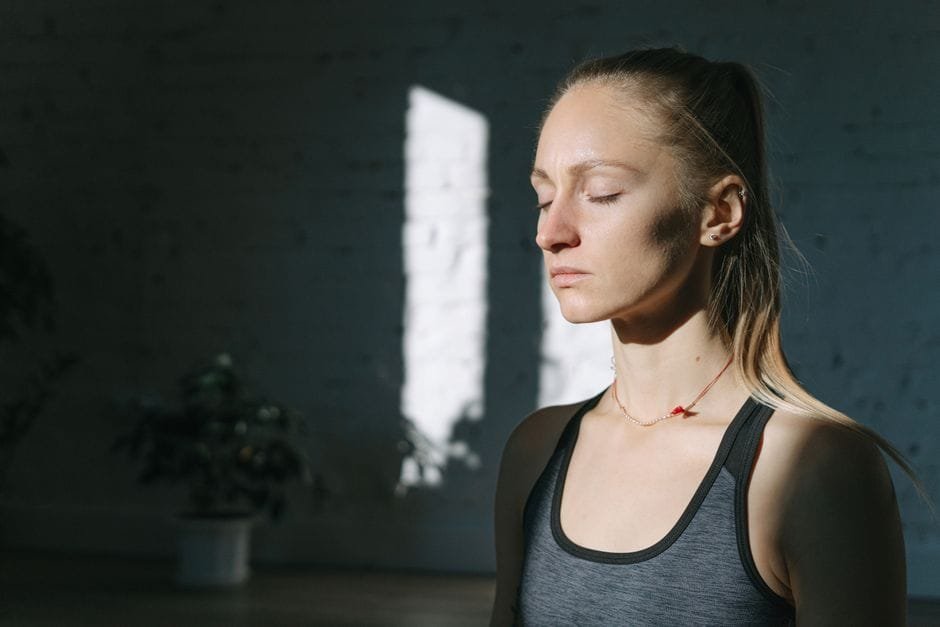
A short stress-recovery routine that fits into a workday sounds great. A new randomized trial tested one: slow, paced breathing combined with blue light. Compared with simply sitting quietly, it cut how stressed people felt by about 31% after a deliberately stressful task.[1] The catch is that the study cannot tell you which part did the work.
What the researchers did
Twenty-nine adults took part in a double-blind crossover trial in a workplace-based lab. Everyone first went through the Maastricht Acute Stress Test, a standard lab method for creating stress. Then each person tried two recovery conditions on separate occasions: passive rest, and the intervention, which paired coherent breathing at 0.1 Hz (one full breath cycle every 10 seconds, or about six breaths a minute) with blue light from a device.[1]
What changed, and what did not
- Felt stress: down 31.23% (CI, 21.41% to 41.83%) on a single-item scale.
- Sleepiness: down 0.84 points (SE 0.17) on the Karolinska Sleepiness Scale.
- Positive mood: up 1.85 points (SE 0.54).
- No significant effect on negative mood, heart rate variability, frontal alpha asymmetry, or the theta/beta ratio, the last two being EEG measures.
The authors read the results as reducing acute stress and lifting mood without causing sleepiness.[1] Note the gap, though. People felt less stressed, but heart rate variability, which many people expect to move with slow breathing, did not change significantly in this trial.
Read this with care
- Two things were bundled. The authors say future work should test breathing and blue light separately. Nothing here shows the light adds anything.
- It is small and short. 29 adults, one session, no follow-up. The authors call for long-term outcomes and more diverse populations.[1]
- There is a commercial link. Four authors are employees of Human design Group, which the paper discloses as a competing interest. It says independent co-authors at Masaryk University ran the statistics to limit bias.[1]
How to use it
You do not need a device to try the breathing half. Slow, paced breathing is free and easy to test on yourself.
- Set a timer for five minutes after a tense meeting or a long stretch of email.
- Breathe in for about five seconds and out for about five. That lands near the six breaths per minute used in the trial. Keep it smooth rather than forced.
- Rate your stress from 0 to 10 before and after. One number each time is enough to see whether it works for you.
- Skip the gadget for now. The trial gives no reason yet to buy the blue light part.
References
[1] Ráčková L, Diamond M, Makarová M, Morcinek P, Butin I, Nemmi F, et al. The effects of coherent breathing and blue light after an acute stress on sleepiness and the stress response in a workplace setting: A randomized double-blind cross-over trial. PLoS One, 2026;21(9):e0357293. Population: 29 adults in a randomized, double-blind crossover design in a workplace-based laboratory, after the Maastricht Acute Stress Test; 0.1 Hz coherent breathing plus blue light versus passive rest. DOI: https://doi.org/10.1371/journal.pone.0357293. Finding as used: the intervention reduced subjective stress by 31.23% (CI 21.41% to 41.83%), decreased sleepiness by 0.84 points (SE 0.17) and increased positive affect by 1.85 points (SE 0.54); no significant effect on negative affect, heart rate variability, frontal alpha asymmetry or theta/beta ratio; the authors recommend evaluating the individual components, long-term outcomes and diverse populations; four authors are employees of Human design Group (disclosed as a competing interest), and statistical analyses were run independently by co-authors at RECETOX, Masaryk University. ↑︎

Kurt Greiner
Kurt is a digital strategist and IT professional blending emerging technology with practical application, exploring how individuals can leverage modern tools to navigate the second half of life with purpose.
Leave a Reply