
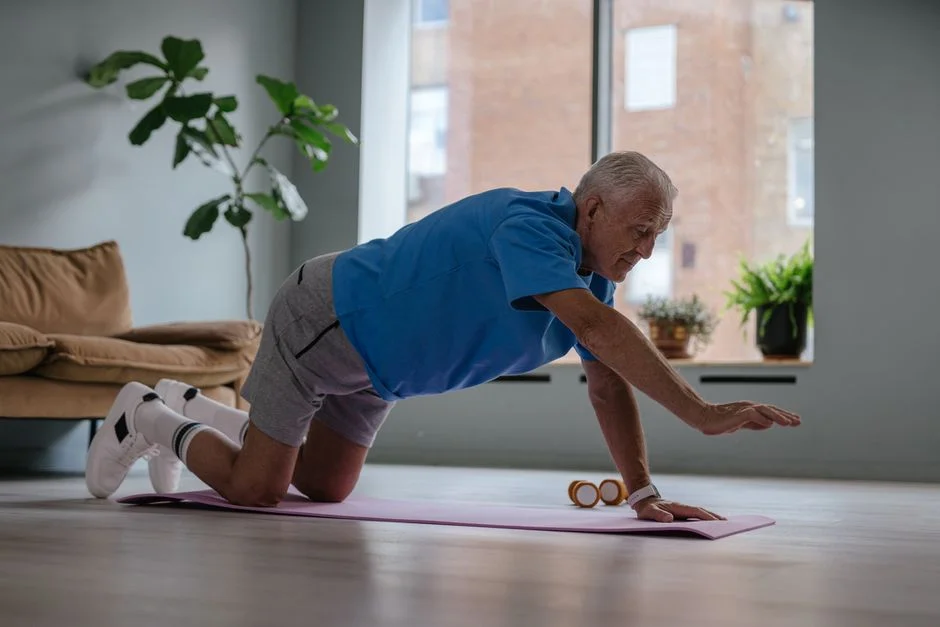
Train your abs like any other muscle, and do not expect that work to shrink the fat above them. A strength coach’s Men’s Health article lists four ab-training myths. Some of it is coaching opinion. Three of the claims connect to published research, so we read the studies. Here is what they found, and where they stop.
The short version: Ab exercises built endurance but did not reduce abdominal fat in a six-week trial. Training a muscle twice a week beat once a week for growth. In one small cadaver study, the number of ab segments was mostly the same, with two exceptions. None of the ab-specific studies tested adults over 40.
Myth: Ab exercises burn belly fat
The article says there is no such thing as spot reduction, meaning fat loss in the area you exercise. In a randomized trial, 24 healthy, sedentary adults aged 18 to 40 either did seven abdominal exercises (two sets of 10, five days a week) for six weeks or did nothing extra. Everyone kept an isocaloric diet, meaning one with the same calories as before. The ab-exercise group saw no significant change in body weight, body fat percentage, abdominal circumference or abdominal skinfold thickness. Their curl-up count did improve, to 47 repetitions versus 32 in the control group.[1]
A second study looked at the same question in the arm. Researchers had 104 people train one arm with resistance training for 12 weeks and compared fat in the trained and untrained arms. On MRI, the change in subcutaneous fat (the layer under the skin) did not differ between arms in the full group. Skinfold calipers showed a drop in the trained arm in men only, and the authors read the MRI result as support for no spot reduction.[2]
What these studies do not tell you: the ab trial was small and short, and its participants were 40 or younger. The arm study measured arms, not abs. Neither one tested adults over 40 as a group. They also do not say ab work is pointless. In the ab trial, endurance went up even though the waist did not change.
One more small study points the same way on the muscle side. In 19 overweight and obese women, 12 weeks of abdominal resistance training combined with a calorie-restricted diet increased the thickness of the side abdominal muscles, measured by ultrasound during a drawing-in maneuver. Because diet and training were combined, the study cannot separate their effects.[3]
Myth: Overtraining your abs works against you
The article says abs are not special, and that overtraining any muscle works against you. The research we can point to is about training frequency in general, not abs. A systematic review and meta-analysis compared different weekly training frequencies for muscle growth. Across studies matched for volume (the total amount of work), training a muscle group twice a week produced better growth than once a week. The average effect size was 0.49 for higher frequency versus 0.30 for lower.[4]
What this does not tell you: the studies compared one to three days per week, so they cannot say what happens with daily ab work. Whether three days beats two was still unresolved. The article also says overuse leads to muscle atrophy. We did not find a study to support that for abs, so we are leaving the claim out.
For general fitness, the World Health Organization 2020 guidelines recommend regular muscle-strengthening activity for all age groups.[5] A reasonable reading is that your core belongs in that routine alongside the rest of your muscles, not in a daily add-on.
Myth: Everyone has a six-pack under there
The article says the number and shape of your ab segments is something you are born with. In one small cadaver study, researchers counted the tendinous intersections, the fibrous bands that cross the rectus abdominis (the “six-pack” muscle). Fifty-two of 54 had three; one had four and one had five, so the count was mostly the same, with two exceptions.[6]
What this does not tell you: the sample was small, came from one region of India, and was collected to help surgeons, not to predict how abs look under a layer of fat. It shows the count can differ in a few people. It does not tell you how many segments you will see, or what your abs will look like.
A practical way to use this
None of these studies is specific to adults over 40, which is our readership, so treat this as a sensible starting point, not a prescription. A common starting point, drawn from general muscle-training research rather than ab-specific studies, is two non-consecutive days a week; add resistance or difficulty gradually, and track something you control, like curl-up repetitions or how long you can hold a plank. Judge progress by that number, not by the waist measurement. If you have back pain, a hernia or a recent surgery, talk to your clinician before starting a new core program.
For a routine to try, see Build a Stronger Core With This Standing Ab Routine You Can Do Anywhere. For more on the twice-a-week point, see Minimal-Dose Strength Training: What the Review Says. For more myth-checking, see Exercise Myths After 50: What Three Studies Actually Found.
References
[1] Vispute SS, Smith JD, LeCheminant JD, Hurley KS. The effect of abdominal exercise on abdominal fat. Journal of Strength and Conditioning Research, 2011;25(9):2559-2564. Population: 24 healthy, sedentary adults aged 18 to 40 (14 men, 10 women), randomized to 6 weeks of abdominal exercise (7 exercises, 2 sets of 10, 5 days/week) or control, isocaloric diet. DOI: https://doi.org/10.1519/JSC.0b013e3181fb4a46. Finding as used: no significant effect of abdominal exercise on body weight, body fat percentage, android fat, abdominal circumference, abdominal skinfold or suprailiac skinfold; curl-up repetitions 47 ± 13 versus 32 ± 9 on the posttest; six weeks of abdominal exercise alone was not sufficient to reduce abdominal subcutaneous fat. ↑︎
[2] Kostek MA, Pescatello LS, Seip RL, et al. Subcutaneous fat alterations resulting from an upper-body resistance training program. Medicine & Science in Sports & Exercise, 2007;39(7):1177-1185. Population: 104 subjects (45 men, 59 women), 12 weeks of supervised resistance training of the nondominant arm. DOI: https://doi.org/10.1249/mss.0b0138058a5cb. Finding as used: MRI subcutaneous fat changes did not differ between trained and untrained arms in the total sample or by gender; skinfold measurements showed a decrease in the trained arm in men only (P < 0.01); the authors state the MRI findings support the notion that spot reduction does not occur as a result of resistance training. ↑︎
[3] Noormohammadpour P, Kordi R, Dehghani S, Rostami M. The effect of abdominal resistance training and energy restricted diet on lateral abdominal muscles thickness of overweight and obese women. Journal of Bodywork and Movement Therapies, 2012;16(3):344-350. Population: 19 overweight and obese women, 12 weeks. DOI: https://doi.org/10.1016/j.jbmt.2011.12.001. Finding as used: muscle thickness of the lateral abdominal muscles, measured by ultrasonography, increased significantly during the drawing-in maneuver after 12 weeks of concurrent abdominal resistance training and energy-restricted diet; the combined design does not separate the effects of training and diet. ↑︎
[4] Schoenfeld BJ, Ogborn D, Krieger JW. Effects of resistance training frequency on measures of muscle hypertrophy: a systematic review and meta-analysis. Sports Medicine, 2016;46(11):1689-1697. Population: experimental trials directly comparing weekly resistance training frequencies, minimum duration 4 weeks. DOI: https://doi.org/10.1007/s40279-016-0543-8. Finding as used: higher frequency was associated with a greater hypertrophy effect size than lower frequency (0.49 ± 0.08 versus 0.30 ± 0.07; P = 0.002); for 1 to 3 days per week on a volume-equated basis, training twice a week promoted superior hypertrophic outcomes to once a week; whether three times a week beats twice a week remains to be determined. ↑︎
[5] Bull FC, Al-Ansari SS, Biddle S, et al. World Health Organization 2020 guidelines on physical activity and sedentary behaviour. British Journal of Sports Medicine, 2020;54(24):1451-1462. Population: guideline for all age groups. DOI: https://doi.org/10.1136/bjsports-2020-102955. Finding as used: the guidelines recommend regular muscle-strengthening activity for all age groups. ↑︎
[6] Anita, Haque M, Gupta A, Nasar A. Variation in tendinous intersections of rectus abdominis muscle in North Indian population with clinical implications. Journal of Clinical and Diagnostic Research, 2015;9(6):AC10-AC12. Population: 54 cadavers of North Indian origin. DOI: https://doi.org/10.7860/JCDR/2015/14027.6028. Finding as used: 52 cadavers (96.29%) had three tendinous intersections, one (1.85%) had four and one (1.85%) had five; the authors note this is a small sample that illustrates anatomical variation. ↑︎

Kurt Greiner
Kurt is a digital strategist and IT professional blending emerging technology with practical application, exploring how individuals can leverage modern tools to navigate the second half of life with purpose.
Leave a Reply