
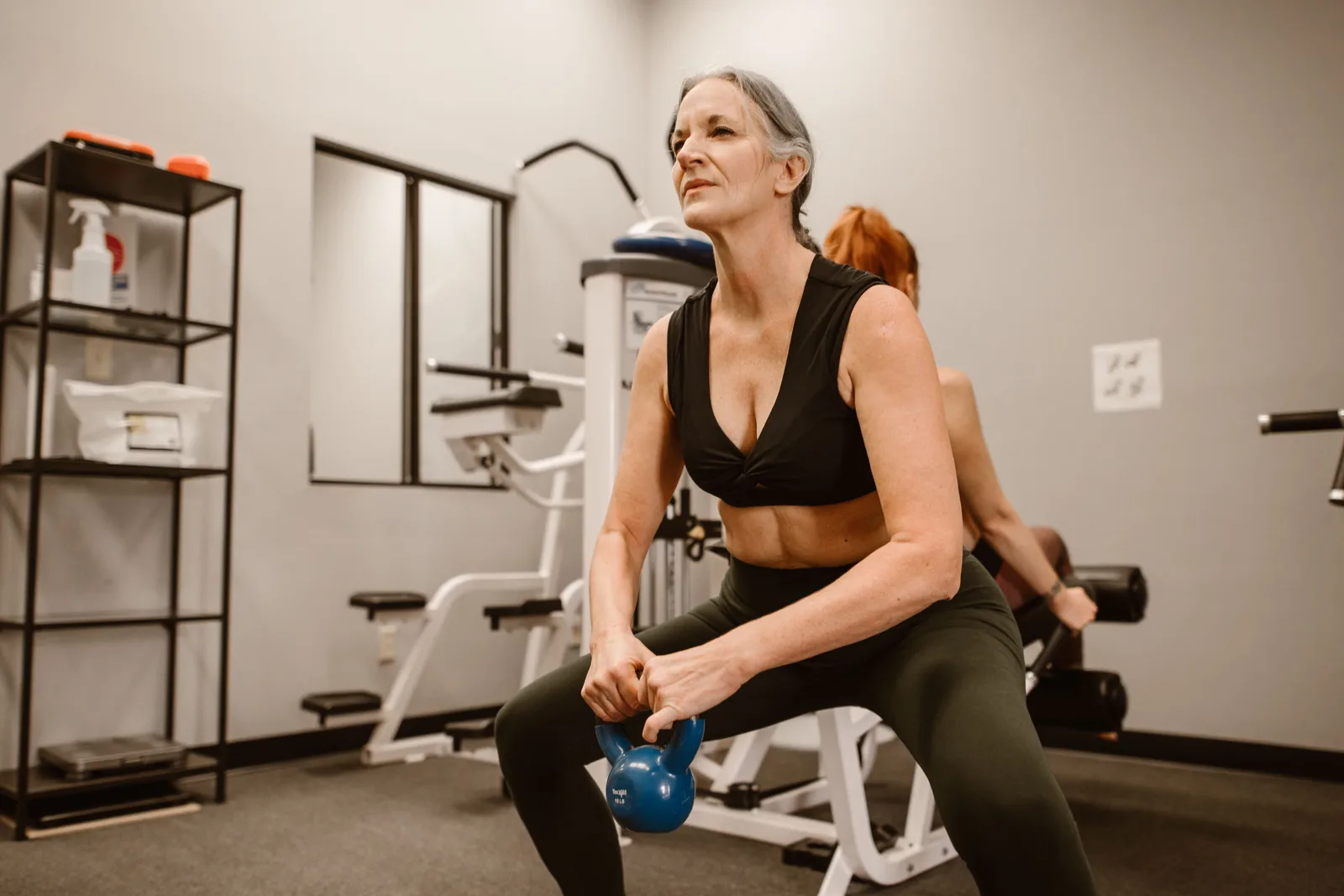
The one bone-loading program we found with randomized-trial results in this group is short and heavy: two supervised 30-minute sessions a week, built around lifts near your limit. In the LIFTMOR trial, women with low bone mass who did this for eight months gained spine bone density while a gentler home program group lost some.[1] The trial was done in postmenopausal women under close supervision, so treat it as a plan to bring to your clinician, not something to copy alone in your garage.
What the trial did
LIFTMOR was a randomized controlled trial of 101 postmenopausal women (average age 65) with low bone mass, meaning a T-score below -1.0. The researchers screened out conditions and medications that affect bone and physical function. Forty-nine women did high-intensity resistance and impact training (HiRIT): twice a week for 30 minutes, supervised, doing 5 sets of 5 repetitions at more than 85% of their one-repetition maximum. The other 52 followed a low-intensity, home-based exercise program.[1]
What it found
- Lumbar spine bone mineral density improved significantly more in the HiRIT group than in the comparison group (p < 0.001).
- Femoral neck bone density also improved significantly more in the HiRIT group (p = 0.004).
- Every functional test favored HiRIT: timed up-and-go, functional reach, five times sit-to-stand, and back and leg strength (all p < 0.001).
- Attendance was high in the HiRIT group, and the only adverse event reported was a minor lower back spasm.
A follow-up analysis of the same participants looked for vertebral fractures on spine scans. The HiRIT group showed no change in fracture classification and a larger reduction in thoracic kyphosis (forward rounding of the upper back) than the comparison group. One new wedge deformity of a vertebra appeared in the comparison group.[2]
What the trial cannot say
- The authors describe the result as holding “under highly supervised conditions” in otherwise healthy postmenopausal women. It does not show that unsupervised heavy lifting is safe for people with osteoporosis.[1]
- It measured bone density and function, not fractures. Scan changes are a stand-in for fracture risk, not proof that fractures dropped.
- It ran eight months in women around age 65. The abstract does not cover men, women before menopause, or people in their 40s and 50s.
- HiRIT combined heavy lifting with impact work, and the results do not separate the two. The comparison group did low-intensity exercise, not nothing.
What to do with it
- Ask your clinician whether a bone-density scan (DXA) makes sense for you. Mention it especially after menopause, after a fracture, or if you take medications that affect bone.
- If you have osteoporosis or low bone mass, ask for a referral to a physical therapist or trainer who works with bone health and can supervise heavy lifting. The trial’s loads were set by supervisors after screening.
- If your clinician clears you, aim for the trial’s dose: two sessions a week of about 30 minutes, working toward 5 sets of 5 repetitions with a heavy load. Build up gradually (our wording) and leave jumping or other impact work for your supervisor to introduce.
- Track function between scans. Time five sit-to-stands from a standard chair once a month and write the number down. The trial used the same test.
If you take one thing, take step one: find out where your bone density stands before you choose a plan. Everything else, including how heavy and how often, should come from someone who has seen your scan and watched you move.
References
[1] Watson SL, Weeks BK, Weis LJ, et al. High-intensity resistance and impact training improves bone mineral density and physical function in postmenopausal women with osteopenia and osteoporosis: the LIFTMOR randomized controlled trial. J Bone Miner Res. 2018;33(2):211-220. DOI: 10.1002/jbmr.3284. Finding as used: 101 postmenopausal women with low bone mass (T-score below -1.0; mean age 65 plus or minus 5 years) were randomized to 8 months of twice-weekly, 30-minute supervised HiRIT (5 sets of 5 repetitions at over 85% 1RM; n=49) or a home-based low-intensity program (n=52). HiRIT was superior for lumbar spine BMD (p<0.001), femoral neck BMD (p=0.004) and all functional performance measures (p<0.001). HiRIT compliance was high, with one adverse event (minor lower back spasm). The authors report no adverse events “under highly supervised conditions” in otherwise healthy postmenopausal women. ↑︎
[2] Watson SL, Weeks BK, Weis LJ, et al. High-intensity exercise did not cause vertebral fractures and improves thoracic kyphosis in postmenopausal women with low to very low bone mass: the LIFTMOR trial. Osteoporos Int. 2019;30(5):957-964. DOI: 10.1007/s00198-018-04829-z. Finding as used: In LIFTMOR participants, the HiRIT group showed no change in vertebral fracture classification and a larger reduction in standing-tall thoracic kyphosis than controls (-6.7 vs -1.6 degrees, p=0.031); a single new wedge deformity was observed in the control group. Supervised HiRIT was not associated with increased vertebral fracture risk. ↑︎

Kurt Greiner
Kurt is a digital strategist and IT professional blending emerging technology with practical application, exploring how individuals can leverage modern tools to navigate the second half of life with purpose.
Leave a Reply