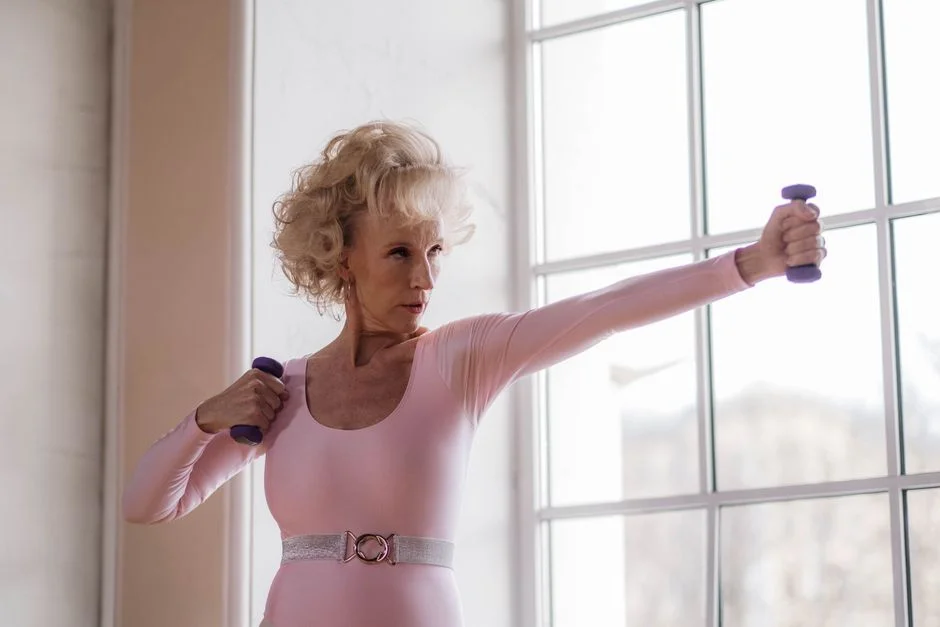
If you are 65 or older and thinking about losing weight, bring it up at your annual wellness visit. Say it plainly, ask how to do it without losing muscle, and ask whether medication belongs in the plan at all. That conversation is the best place to start.
Everyday Health recently ran a piece on exactly this, quoting two physicians who make the same point: after 65, the goal is not a lower number on the scale. It is less excess fat while keeping muscle, strength, bone, and independence. We checked what the research behind that advice actually shows.
Why muscle is the thing to protect
Weight loss does not take only fat. In a six-month clinical trial of 160 older adults with obesity, everyone in the weight-management groups lost about 9% of body weight, but what they lost depended on how they moved. Lean mass fell 5% in the aerobic-only group, 3% in the group combining aerobic and resistance training, and 2% in the resistance-only group. Hip bone density dropped by about 3% with aerobic exercise alone, versus about 1% or less in the other two exercise groups.[1]
The combined group also improved the most on a physical performance test (a 21% gain, versus 14% for either type alone). The researchers concluded that weight loss plus both kinds of exercise was the most effective of the approaches tested for improving function.[1]
The practical takeaway: in this trial, the aerobic-only group lost more lean mass than the groups that added resistance training, so ask your doctor or a physical therapist whether resistance work is right for you.
How to open the conversation
You do not need a script, but a plain opening helps. Something like: “I would like to lose some weight because I think it is affecting my health and mobility. I want to do it safely and keep my muscle. Should I lose weight, and what is the safest way for me?” Then add the question many people skip: “Is medication appropriate for me, or should I start with food and exercise?”
Before the visit, spend five minutes on two things:
- Your reason. A health goal such as blood pressure, easier stairs, and fitting into old clothes are all legitimate, and each points to a different plan.
- Your history. What worked before, what did not, and what you could not stick with.
Where medication and surgery fit
Weight-loss medication is a real option your doctor may raise, and worth asking about directly. The American College of Physicians published a living guideline in 2026 that conditionally suggests starting a medication alongside lifestyle changes for adults with obesity (BMI of 30 or higher), with semaglutide and tirzepatide as first-line choices based on moderate-certainty evidence. For adults with a BMI of 27 to 30 who also have conditions such as type 2 diabetes, high blood pressure, or sleep apnea, it makes a similar suggestion.[2]
The same guideline says clinicians and patients should talk through benefits, harms, cost, access, other health conditions, weight loss goals, life expectancy, and personal preferences before choosing. That is a good checklist to bring with you. Do not start, stop, or change a medication on your own.
Bariatric surgery is a separate decision for a specialist team. Professional societies updated their indications for it in 2022, replacing guidance that dated to 1991, and whether you qualify depends on your individual health.[3]
What this does not tell you
The exercise trial was small, lasted six months, and compared groups on short-term function and body composition; it cannot tell us about long-term outcomes such as falls or lifespan. The ACP guideline covers adults of all ages and is not specific to people over 65, so how its medication suggestions apply to you is exactly what to ask your own clinician. Neither source says how much weight any one person should lose. That is the individual call this visit is for.
References
- Villareal DT, Aguirre L, Gurney AB, et al. “Aerobic or Resistance Exercise, or Both, in Dieting Obese Older Adults.” New England Journal of Medicine, 2017;376(20):1943-1955. DOI: 10.1056/NEJMoa1616338. Finding used: in 160 obese older adults over 6 months, body weight fell 9% in all exercise groups; lean mass fell 3% (combined), 2% (resistance), and 5% (aerobic); total hip bone density fell about 1%, 0.5%, and 3% respectively; the combined group improved most on the Physical Performance Test (21% vs 14%). ↑︎ a b
- Qaseem A, Cross JT Jr, Harrod CS, et al. “Pharmacologic Treatments With Lifestyle Modifications in Nonpregnant Adults With Overweight or Obesity in Outpatient Settings: A Living Clinical Guideline From the American College of Physicians (April 2026).” Annals of Internal Medicine, 2026;179(8):1177-1185. DOI: 10.7326/ANNALS-25-02714. Finding used: conditional recommendations to initiate medication with lifestyle modification for BMI of 30 or higher (semaglutide and tirzepatide first-line, moderate-certainty evidence) and for BMI 27 to 30 with specified comorbidities; clinicians and patients should discuss benefits, harms, costs, comorbidities, weight loss goals, life expectancy, and preferences. ↑︎
- Eisenberg D, Shikora SA, Aarts E, et al. “2022 American Society for Metabolic and Bariatric Surgery (ASMBS) and International Federation for the Surgery of Obesity and Metabolic Disorders (IFSO): Indications for Metabolic and Bariatric Surgery.” Surgery for Obesity and Related Diseases, 2022;18(12):1345-1356. DOI: 10.1016/j.soard.2022.08.013. Finding used: the 2022 statement is a major update to the 1991 NIH guidelines for bariatric surgery. ↑︎

Kurt Greiner
Kurt is a digital strategist and IT professional blending emerging technology with practical application, exploring how individuals can leverage modern tools to navigate the second half of life with purpose.
Leave a Reply