
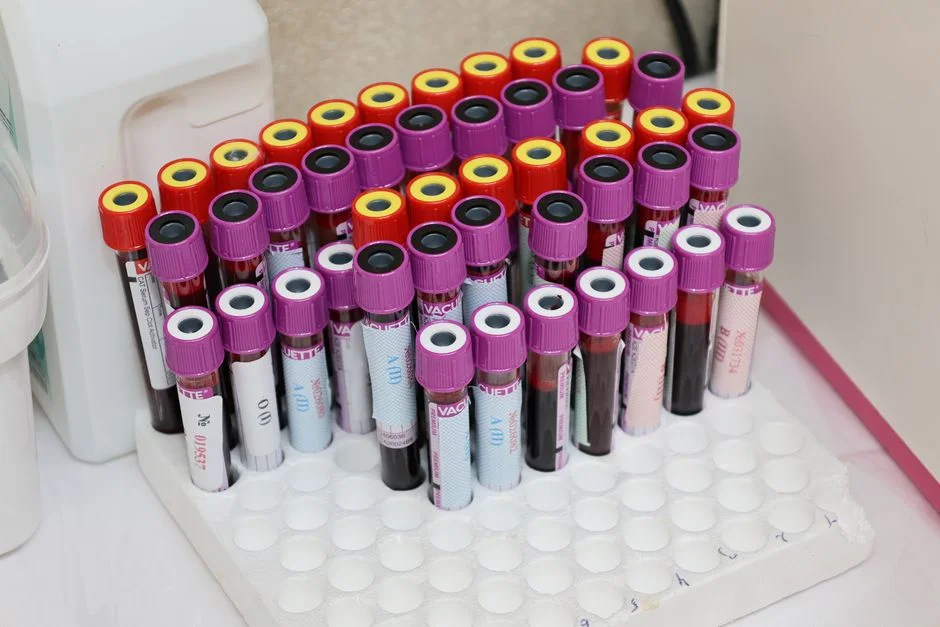
The wellness industry has turned annual blood work into an anxiety generator. Lists of seven, ten, fourteen markers – each with an “optimal” range that shifts depending on who is selling the test. The result is a lot of people worried about their homocysteine while their cardiovascular risk, metabolic trend, and inflammation level go unexamined. This page is the short overview of three tests; for a closer look at apoB and what a standard lipid panel leaves out, see Why Standard Lipid Panels Can Tell an Incomplete Story.
The Three Tests at a Glance
- ApoB: Counts the atherogenic particles in your blood – a measure that has predicted cardiovascular risk better than LDL cholesterol alone in a meta-analysis of published studies.
- Fasting Insulin: Shows how much insulin your body makes to keep glucose steady. It can rise while blood sugar is still in the normal range. No source cited here sets a cutoff for it or shows that testing it improves outcomes.
- hs-CRP: Measures low-grade inflammation, a marker associated with higher cardiovascular risk in population studies.
Bettering Me treats these three as useful questions to take to your clinician, a reasonable place to start before looking at other markers. Each looks at a different area – cardiovascular particles, glucose and insulin handling, and inflammation – and none of them is a diagnosis by itself.
ApoB counts atherogenic particles. Each LDL, VLDL, chylomicron, and lipoprotein(a) particle carries one apoB molecule.[1] LDL-C, the standard measurement, estimates the mass of cholesterol inside LDL particles and doesn’t count the particles. A narrative review argues that apoB more accurately measures the atherogenic risk of these particles than LDL-C or non-HDL-C,[1] and a meta-analysis of 12 reports covering 233,455 people found apoB to be the most potent marker of cardiovascular risk, LDL-C the least, and non-HDL-C in between.[2]
Two people can have the same LDL-C and different particle counts, because the amount of cholesterol per particle varies. In a cohort of 6,814 people free of cardiovascular disease, LDL-C and LDL particle number disagreed in many people, and among those whose values disagreed, only particle number was associated with later cardiovascular events. That study measured LDL particle number by NMR, not apoB.[3] The 2019 ESC/EAS dyslipidaemia guidelines treat higher apoB as higher risk, with secondary goals of below 65, 80, and 100 mg/dL for people at very high, high, and moderate cardiovascular risk, respectively.[4] Your risk category is something your clinician assesses; it is not read off one number.
Fasting insulin is a window on metabolic trend. Fasting glucose can stay normal while the body compensates for reduced insulin sensitivity by secreting more insulin, until the compensation is no longer enough.[5] The ADA criteria for prediabetes are an A1C of 5.7-6.4% or a fasting plasma glucose of 100-125 mg/dL, and fasting insulin is not part of them.[6] The sources cited here do not give a cutoff for fasting insulin, so the number needs your clinician’s interpretation. HOMA-IR is a calculation from fasting glucose and fasting insulin. Its 1985 developers found that it correlated with the euglycemic clamp (Rs = 0.88), and also noted that its low precision limits its use.[7]
hs-CRP is an inflammation marker. The 2018 AHA/ACC cholesterol guideline lists an elevated hs-CRP of 2.0 mg/L or higher, if measured, as one of several risk-enhancing factors that clinicians can weigh when deciding whether a person at borderline or intermediate 10-year risk should start a statin.[11] It is not a diagnosis, and it does not replace the major risk factors. An earlier CDC and American Heart Association statement from 2003 described hs-CRP cutpoints of below 1.0 mg/L (lower relative risk), 1.0 to 3.0 mg/L (average), and above 3.0 mg/L (higher), which correspond to approximate tertiles in the adult population; a meta-analysis of prospective studies it reviewed found about twice the odds of coronary events in the top tertile compared with the bottom (relative odds 2.0, 95% CI 1.6-2.5).[8] That 2003 statement is more cautious than the wellness conversation. It supports optional hs-CRP testing for people without known cardiovascular disease whose 10-year coronary risk is intermediate (10-20%), discourages using it in place of major risk factors, advises two measurements about two weeks apart, and says a result above 10 mg/L should prompt a search for infection or inflammation and a repeat test. It also advises against serial hs-CRP testing to monitor treatment.[8] A single hs-CRP value is a prompt for a conversation with your clinician, not a diagnosis.
Homocysteine, vitamin D, and thyroid panels may matter for particular people, and whether they matter for you is a question for your clinician. The extra tests make most sense once you know your overall risk.
The one exception is Lp(a) – lipoprotein(a) – which is worth checking once. Its heritability exceeds 90%,[10] and its concentrations are not much influenced by diet or physical activity.[9] A 2022 European Atherosclerosis Society consensus statement recommends measuring Lp(a) at least once in adults, and suggests above 50 mg/dL (125 nmol/L) as a level that rules in higher risk.[10] Lp(a) isn’t a substitute for apoB – it’s an additional risk factor. If it is high, the panel recommends early, intensive management of other risk factors according to your baseline risk, which is a plan to build with your clinician.[10]
Bettering Me’s approach: understand these anchors first, with your clinician, and chase the extras only once they are known.
How to get these tests. Standard lab panels typically report total cholesterol, LDL-C, HDL-C, and triglycerides. Ask your clinician about “apolipoprotein B,” “insulin, fasting,” and “C-reactive protein, high sensitivity” by name. Coverage and cost vary by lab and insurance, so check before ordering.
How often to retest. That is a decision for you and your clinician. The 2003 CDC/AHA statement advises against using serial hs-CRP testing to monitor treatment.[8]
Your ApoB, fasting insulin, and hs-CRP results are most useful when a clinician who knows your history helps you read them.
References
↑︎ Sniderman AD, Thanassoulis G, Glavinovic T, et al. Apolipoprotein B particles and cardiovascular disease: a narrative review. JAMA Cardiol. 2019;4(12):1287-1295. DOI: https://doi.org/10.1001/jamacardio.2019.3780
↑︎ Sniderman AD, Williams K, Contois JH, et al. A meta-analysis of low-density lipoprotein cholesterol, non-high-density lipoprotein cholesterol, and apolipoprotein B as markers of cardiovascular risk. Circ Cardiovasc Qual Outcomes. 2011;4(3):337-345. DOI: https://doi.org/10.1161/CIRCOUTCOMES.110.959247
↑︎ Otvos JD, Mora S, Shalaurova I, et al. Clinical implications of discordance between low-density lipoprotein cholesterol and particle number. J Clin Lipidol. 2011;5(2):105-113. DOI: https://doi.org/10.1016/j.jacl.2011.02.001
↑︎ Mach F, Baigent C, Catapano AL, et al. 2019 ESC/EAS Guidelines for the management of dyslipidaemias: lipid modification to reduce cardiovascular risk. Eur Heart J. 2020;41(1):111-188 (apoB secondary goals: p. 132 and Table 7, p. 133). DOI: https://doi.org/10.1093/eurheartj/ehz455
↑︎ DeFronzo RA, Tripathy D. Skeletal muscle insulin resistance is the primary defect in type 2 diabetes. Diabetes Care. 2009;32(Suppl 2):S157-S163. DOI: https://doi.org/10.2337/dc09-S302
↑︎ American Diabetes Association Professional Practice Committee. 2. Diagnosis and classification of diabetes: Standards of Care in Diabetes-2025. Diabetes Care. 2025;48(Suppl 1):S27-S49. DOI: https://doi.org/10.2337/dc25-S002
↑︎ Matthews DR, Hosker JP, Rudenski AS, et al. Homeostasis model assessment: insulin resistance and beta-cell function from fasting plasma glucose and insulin concentrations in man. Diabetologia. 1985;28(7):412-419. DOI: https://doi.org/10.1007/BF00280883
↑︎ Pearson TA, Mensah GA, Alexander RW, et al. Markers of inflammation and cardiovascular disease: application to clinical and public health practice: a statement for healthcare professionals from the Centers for Disease Control and Prevention and the American Heart Association. Circulation. 2003;107(3):499-511. DOI: https://doi.org/10.1161/01.CIR.0000052939.59093.45
↑︎ Kronenberg F. Human genetics and the causal role of lipoprotein(a) for various diseases. Cardiovasc Drugs Ther. 2016;30(1):87-100. DOI: https://doi.org/10.1007/s10557-016-6648-3
↑︎ Kronenberg F, Mora S, Stroes ESG, et al. Lipoprotein(a) in atherosclerotic cardiovascular disease and aortic stenosis: a European Atherosclerosis Society consensus statement. Eur Heart J. 2022;43(39):3925-3946. DOI: https://doi.org/10.1093/eurheartj/ehac361
↑︎ Grundy SM, Stone NJ, Bailey AL, et al. 2018 AHA/ACC/AACVPR/AAPA/ABC/ACPM/ADA/AGS/APhA/ASPC/NLA/PCNA guideline on the management of blood cholesterol: a report of the American College of Cardiology/American Heart Association Task Force on Clinical Practice Guidelines. Circulation. 2019;139(25):e1082-e1143. DOI: https://doi.org/10.1161/CIR.0000000000000625

Kurt Greiner
Kurt is a digital strategist and IT professional blending emerging technology with practical application to help businesses and individuals streamline their digital presence. His current work focuses on the intersection of intentional living and technological resilience, exploring how individuals can leverage modern tools to navigate the second half of life with purpose.
Leave a Reply