
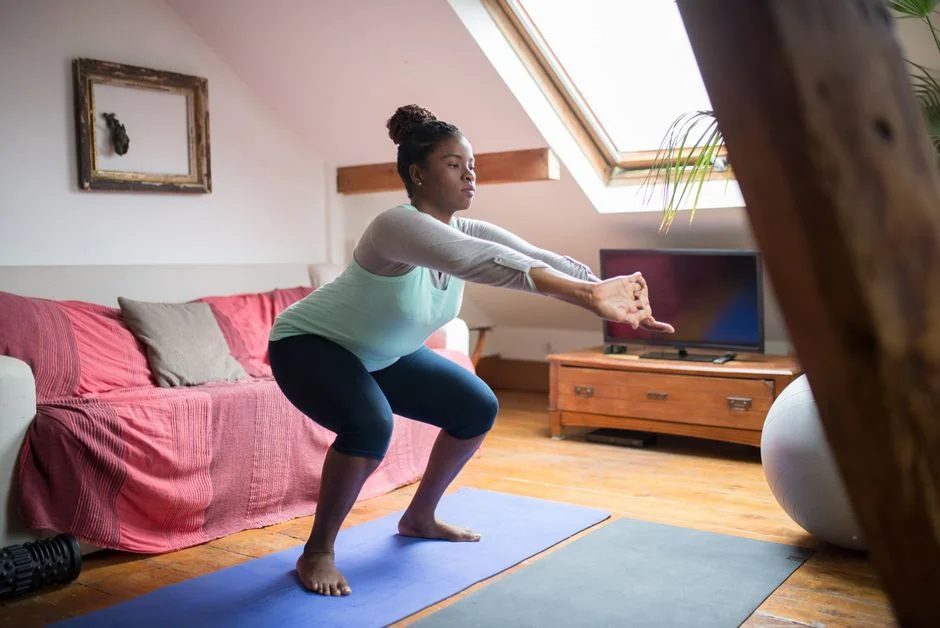
Tendon pain at the heel or knee. Stretching is a common default; none of these trials tested it. This post looks at what four clinical trials found about strength exercise for tendinopathy, and what they left unanswered.
What the trials tested
None of the trials below tested stretching against strength work. What they compared was different ways of loading the tendon. That matters for the headline idea that strength exercise helps “without stretching”: the studies found symptom improvement with strength-based loading, but they cannot say stretching is useless.
Heavy, slow lifting for the Achilles tendon
A randomized controlled trial assigned 58 people with long-standing (over 3 months) midportion Achilles tendinopathy to 12 weeks of either eccentric training or heavy slow resistance training. Both groups improved significantly on function and on pain during activity, and the gains were still there at the 52-week follow-up. The two programs did not differ on those outcomes. People in the heavy slow resistance group attended more of their sessions (92% compared with 78%).[1]
The practical takeaway is that a program built on slow, heavy resistance training worked as well as the older eccentric approach, and people attended more sessions (92% vs 78%).
Progressive loading for the knee
A second trial enrolled 76 people with patellar tendinopathy (tendon pain below the kneecap). One group followed a progressive tendon-loading program, which builds load in stages. The other did eccentric exercise therapy. After 24 weeks, the progressive-loading group improved by 28 points on the VISA-P questionnaire (pain, function and ability to play sport) compared with 18 points in the eccentric group. The adjusted difference was 9 points (95% confidence interval 1 to 16).[2] The interval is wide, so the size of the advantage is uncertain. Return-to-sport rates and satisfaction did not differ significantly.
Holds for short-term pain relief
An isometric contraction means tensing a muscle against resistance without moving the joint, such as holding a wall sit. A small crossover trial of 6 volleyball players with patellar tendinopathy reported that one bout of isometric contractions cut pain during a single-leg decline squat from about 7 to nearly 0 on a 10-point scale, and the relief lasted at least 45 minutes. Isotonic (moving) contractions cut it from about 6 to under 4.[3]
That result got less convincing when a larger crossover trial of 21 people tried to repeat it. Pain dropped by an average of 0.9 points right after exercise, the drop was gone by 45 minutes, and isometric work was no better than dynamic resistance exercise.[4] Holds may help some people feel better for a short window, but the evidence does not show they are special.
What this does not show
- No trial here compared strength work with stretching, so the “without stretching” claim is not tested.
- The trials covered the Achilles and patellar tendons. Results may not carry over to the shoulder, elbow or hip.
- The isometric pain-relief study had 6 participants, and the larger follow-up found a much smaller effect.
- Two of the trials compared one loading style against another, with no inactive comparison group, so they show equal or better performance than eccentric training, not benefit over doing nothing.
What to do with it
- If a tendon is sore, a loading program such as slow, heavy repetitions with a gradual increase in weight is a reasonable thing to ask a physiotherapist about.
- Pick a program you will actually keep doing. In the Achilles trial, adherence was higher with the heavy slow version.
- Expect weeks, not days.
- Tendon pain that lasts, worsens, follows an injury or comes with swelling or weakness deserves an assessment from a clinician before you start any program.
References
[1] Beyer R, Kongsgaard M, Hougs Kjaer B, Ohlenschlaeger T, Kjaer M, Magnusson SP. Heavy Slow Resistance Versus Eccentric Training as Treatment for Achilles Tendinopathy: A Randomized Controlled Trial. American Journal of Sports Medicine, 2015;43(7):1704-1711. Population: 58 patients with chronic midportion Achilles tendinopathy. DOI: https://doi.org/10.1177/0363546515584760. Finding as used: both groups improved significantly on function and activity pain over 12 weeks, maintained at 52 weeks, with no difference between groups; session compliance was 92% with heavy slow resistance and 78% with eccentric training. ↑︎
[2] Breda SJ, Oei EHG, Zwerver J, Visser E, Waarsing E, Krestin GP, de Vos RJ. Effectiveness of progressive tendon-loading exercise therapy in patients with patellar tendinopathy: a randomised clinical trial. British Journal of Sports Medicine, 2021;55(9):501-509. Population: 76 patients with ultrasound-confirmed patellar tendinopathy. DOI: https://doi.org/10.1136/bjsports-2020-103403. Finding as used: VISA-P improved 28 vs 18 points at 24 weeks (adjusted between-group difference 9, 95% CI 1 to 16, p=0.023); no significant difference in satisfaction or adherence. ↑︎
[3] Rio E, Kidgell D, Purdam C, Gaida J, Moseley GL, Pearce AJ, Cook J. Isometric exercise induces analgesia and reduces inhibition in patellar tendinopathy. British Journal of Sports Medicine, 2015;49(19):1277-1283. Population: 6 volleyball players with patellar tendinopathy. DOI: https://doi.org/10.1136/bjsports-2014-094386. Finding as used: single-leg decline squat pain fell from 7.0 to 0.17 after isometric contractions and from 6.33 to 3.75 after isotonic contractions; the isometric reduction was sustained at 45 minutes. ↑︎
[4] Holden S, Lyng K, Graven-Nielsen T, Riel H, Olesen JL, Larsen LH, Rathleff MS. Isometric exercise and pain in patellar tendinopathy: A randomized crossover trial. Journal of Science and Medicine in Sport, 2020;23(3):208-214. Population: 21 participants with patellar tendinopathy. DOI: https://doi.org/10.1016/j.jsams.2019.09.015. Finding as used: mean pain reduction of 0.9 points on a 0-10 scale immediately after exercise, not sustained at 45 minutes, with no difference between isometric and dynamic resistance exercise. ↑︎

Kurt Greiner
Kurt is a digital strategist and IT professional blending emerging technology with practical application, exploring how individuals can leverage modern tools to navigate the second half of life with purpose.
Leave a Reply