
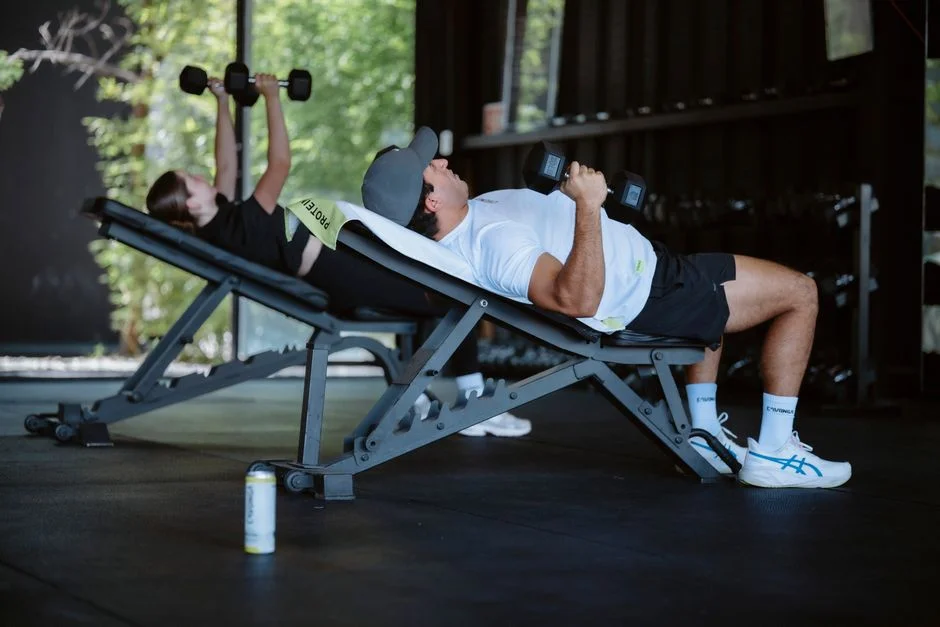
If you are stuck on the same weight for the same reps, a rest-pause set is one way to squeeze more work out of a set without dropping the load. Pick one exercise, take it to the point where you cannot complete another rep with good form, rest about 5 to 15 seconds, then do a few more reps with the same weight. That is the whole technique, and one small trial suggests it can hold its own against a standard set-and-rest plan.
What the trial compared
Researchers randomly assigned 18 trained adults to six weeks of either traditional multiple-set training or rest-pause training in a randomized trial. The traditional group did 3 sets of 6 repetitions at 80% of their one-repetition maximum with 2-minute rests between sets. Each group had 9 people (7 men and 2 women), averaging about 30 years old.[1]
The abstract does not spell out the rest-pause protocol. Men’s Health describes the version used in the study as one set to failure followed by as many short-rest sets as needed to reach 18 total reps, which matches the traditional group’s 3 x 6. Treat that detail as secondhand.
What the trial found
- Strength: no significant difference between groups in 1RM for the bench press, leg press or biceps curl (p > 0.05).[1]
- Thigh muscle thickness: the rest-pause group gained about 11%, versus about 1% in the traditional group. This was the only site that differed.[1]
- Leg-press endurance: the rest-pause group improved its repetitions by about 27%, versus about 8% for the traditional group. The other exercises did not differ.[1]
In plain terms, rest-pause training built strength about as well as the usual approach, with a possible edge in thigh size and leg endurance. The authors concluded the same.[1]
How reliable is that
Not very, yet. Treat this as a reason to experiment, not as proof.
- The sample is tiny: nine people per group, and only two women per group.
- It ran for six weeks in people already used to lifting, with an average age near 30. It tells us nothing about adults over 40 or beginners.
- The spread within each group was large. Several reported changes had standard deviations as big as the average gain, which is why most outcomes showed no clear difference.
- Only one of several muscle and endurance measures favored rest-pause, and the trial did not test whether the gain would hold up over months.
How to try a rest-pause set
The practical steps below come from the Men’s Health explainer, not from the trial. The trial supports the idea, not these exact numbers.
- Pick one exercise per workout, ideally one where you have stalled, and make it the last set of that exercise.
- Take the set to technical failure, the point where you cannot do another rep with good form. Stop there rather than grinding out sloppy reps.
- Rest 5 to 15 seconds. Three slow, deep breaths is a simple way to time it.
- Do a few more reps with the same weight. Expect roughly two to four. One extra round is a good starting point.
- Save it for the end of the workout. These sets are tiring, and using them early can cost you reps on later sets.
Machines and supported moves, such as chest-supported rows or dumbbell curls, are the safer places to start. For the bench press or back squat, use a spotter. If you have high blood pressure, a heart condition or joint pain, talk to your clinician or a qualified trainer before pushing sets to failure.
Keep it occasional. A rest-pause set is hard, so it does not belong on every set or every exercise. If you want a way to gauge effort, the rating of perceived exertion scale can help you notice when a set has truly reached your limit. The source article is Men’s Health, What Rest-Pause Training Can Do for Your Workout.
Bottom line: one rest-pause set at the end of a stalled lift is a low-cost experiment. Track the weight and total reps for a few weeks, and keep it if your numbers move.
References
[1] Prestes J, Tibana RA, de Araujo Sousa E, da Cunha Nascimento D, de Oliveira Rocha P, Camarço NF, Frade de Sousa NM, Willardson JM. Strength and Muscular Adaptations After 6 Weeks of Rest-Pause vs. Traditional Multiple-Sets Resistance Training in Trained Subjects. Journal of Strength and Conditioning Research, 2019;33(7S):S113-S121. Population: 18 trained adults (mean age 30.2 years), randomized to 6 weeks of rest-pause or traditional multiple-set training. DOI: https://doi.org/10.1519/JSC.0000000000001923. Finding as used: no significant difference in 1RM strength between groups (p > 0.05); rest-pause showed greater localized muscular endurance for the leg press only (27% vs 8%) and greater thigh muscle thickness only (11% vs 1%). ↑︎ a b c d e

Kurt Greiner
Kurt is a digital strategist and IT professional blending emerging technology with practical application, exploring how individuals can leverage modern tools to navigate the second half of life with purpose.
Leave a Reply