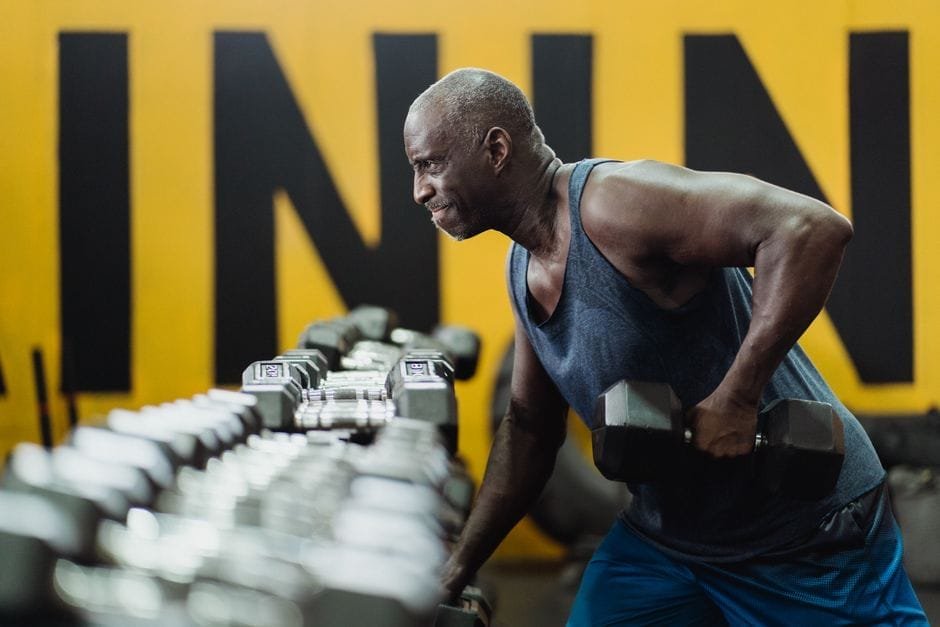
Building bigger muscles and building stronger muscles aren’t the same project. A new meta-analysis pooling 41 clinical trials and over 3,100 older adults asked which interventions actually improve strength relative to muscle size — and only one came out with a clear, statistically significant win.[1]
Why “strength per pound of muscle” matters
Researchers use the term muscle-specific strength for a simple but often-overlooked idea: how much force your muscle produces relative to its size. Two people can have identical muscle mass and still differ enormously in how much force that tissue actually generates — the quality of the muscle, not just its quantity, drives real-world strength. Losing muscle-specific strength is now recognized as a core feature of sarcopenia, the age-related muscle wasting that predicts falls, hospitalizations, and loss of independence.
The study pooled 41 randomized controlled trials — 3,141 participants aged 60 and older, each trial running at least 8 weeks — and compared every intervention type researchers had tested against this specific outcome: resistance exercise, aerobic exercise, concurrent (combined) training, nutritional supplementation, combined exercise-and-nutrition programs, caloric restriction, and other approaches.
The result: one clear winner
Resistance exercise significantly improved muscle-specific strength (standardized mean difference 0.65, 95% CI 0.22 to 1.09, a moderate average effect with a wide range of plausible values). Every other category — aerobic exercise alone, concurrent training, combined exercise-plus-nutrition programs, and nutritional supplementation on its own — did not reach statistical significance for this specific outcome. The authors describe the effects of nutrition and aerobic exercise as inconclusive, which is not the same as showing they have no effect.
That doesn’t mean nutrition or cardio are worthless for older adults — they matter for plenty of other outcomes. But if the specific goal is improving how much force your existing muscle can produce, this review points to one intervention that raised it: loaded resistance training. The researchers note real variability between the pooled studies (a statistical measure called I², at 83.5% here, meaning the trials didn’t all agree closely on effect size, and the authors note high heterogeneity across the included studies), so the exact magnitude of benefit varies by program. The pooled result for resistance exercise was still positive.
What this means for you
If you’re over 60 — or planning ahead for when you will be — and your goal is staying strong, not just staying “active”:
- Make resistance training the anchor, not an add-on. Walking, swimming, and cycling are valuable for cardiovascular and metabolic health, but in this analysis they did not reach significance for muscle-specific strength on their own, and the authors call that inconclusive. This review did not test how often to train, and the trials varied widely in design, so ask a clinician or trained coach what schedule suits you.
- Don’t expect protein or supplements to substitute for lifting. Nutritional supplementation alone did not reach significance in this pooled analysis, and the authors call the effect inconclusive. Adequate protein still supports the process, but it’s a supporting input to resistance training, not a replacement for it.
- Track strength, not just muscle size. A simple way to monitor this yourself: note your working weights on a few key lifts (or resistance-band levels) every few months. Strength trending up over time is a sensible thing to track. This review measured strength relative to muscle size and did not measure falls, hospitalizations, or independence, so it can’t say how much that strength protects you.
If you have heart disease, osteoporosis, joint pain, or balance problems, or you haven’t done resistance training before, ask your clinician or a trained coach how to start.
Bigger muscles are nice. In this review, loaded resistance training was the only approach that significantly raised strength relative to muscle size. The review did not measure falls or independence, so how much that strength helps you stay independent is a question it can’t answer.
References
- Ohta T, Hatanaka S, Li J, et al. “Effects of exercise and nutritional interventions on muscle-specific strength in older adults: A systematic review and meta-analysis.” Ageing Research Reviews, 2026;122:103271. Finding used: pooling 41 RCTs (3,141 participants aged 60+), resistance exercise significantly improved muscle-specific strength (SMD 0.65, 95% CI 0.22-1.09; I² 83.5%), while aerobic exercise, concurrent training, combined exercise-and-nutrition, and nutritional supplementation alone did not produce statistically significant improvements. DOI: 10.1016/j.arr.2026.103271. Source: PubMed 42570706. ↑︎

Kurt Greiner
Kurt is a digital strategist and IT professional blending emerging technology with practical application to help businesses and individuals streamline their digital presence. His current work focuses on the intersection of intentional living and technological resilience, exploring how individuals can leverage modern tools to navigate the second half of life with purpose.
Leave a Reply