
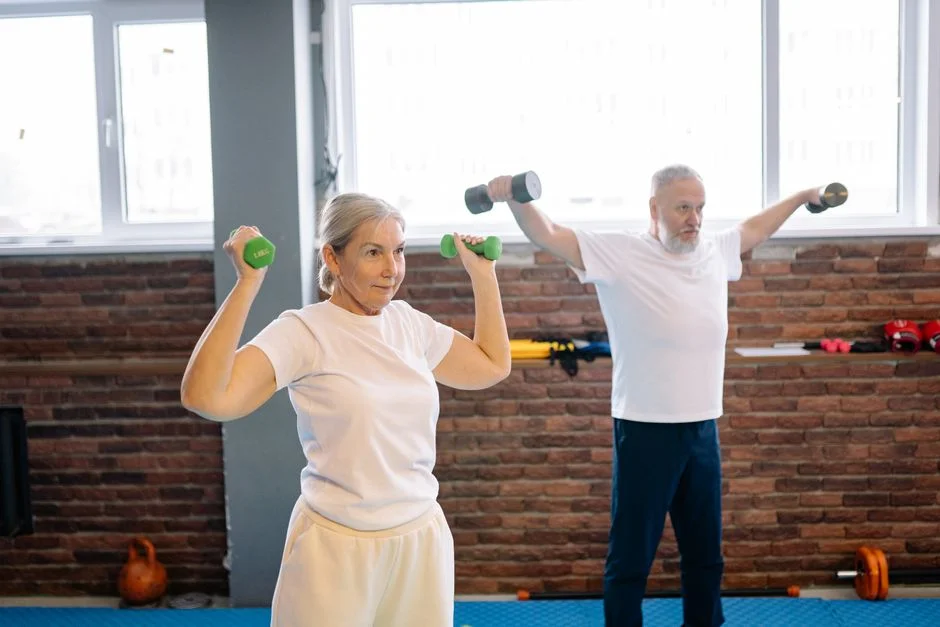
If you are in your 60s or 70s and wondering whether heavy lifting is still worth starting, the best-supported answer is yes: two to three resistance training sessions a week, with weights that go up slowly and coaching on form. A 79-year-old woman describes a routine like that in a recent Women’s Health essay, and the trial evidence points the same way, with limits worth knowing.
What she does
She says exercise was a casual habit for most of her life. In her 70s she read up on staying strong and independent, decided she needed to build muscle, and joined group strength classes at a Burn Boot Camp studio, going five days a week at first. Seven years later she does three strength-focused classes and one or two cardio-focused classes a week, plus reformer Pilates once or twice a week on non-lifting days.
The strength days use dumbbells for presses, rows, deadlifts, Romanian deadlifts, lunges and squat variations. She raises the weight every few weeks. By her account, she moved from 10 to 12 pounds on the overhead press, from 20 to 25 pounds on the chest fly, and hit a 70-pound Romanian deadlift. She also eats more protein than she used to, aims for about 5,000 steps a day, and walks instead of running when a class programs running, because impact bothers her knees.
Those are small numbers by gym standards, and that is the useful part. The gains came from adding weight in small steps and showing up, not from chasing a big lift.
What the trials say
A Cochrane systematic review pooled 121 randomized trials with 6,700 older adults. In most of them, progressive resistance training was done two to three times a week at high intensity. The effect on muscle strength was large (standardized mean difference 0.84). The effect on overall physical ability was small (0.14). Walking speed improved modestly, by about 0.08 meters per second, and getting up from a chair improved moderately to a lot. People with osteoarthritis reported less pain afterward.[1]
The National Strength and Conditioning Association reached a similar conclusion in a position statement, calling resistance training a powerful way to counter the loss of strength and muscle that comes with age, including the physical-function and independence problems that follow.[2] That document is an expert synthesis of the literature, not a single trial.
Limits
- One person’s account is not evidence. We do not know what she would have done without lifting, or how typical her progress is.
- The Cochrane review was published in 2009 and searched through 2007 and 2008. Newer trials exist that it does not include.
- The review’s authors noted that adverse events were poorly recorded. Joint pain and muscle soreness were reported in many trials, and serious events were rare and not directly tied to the exercise.
- Most trials were supervised programs. Her coaching and form feedback matter, and the studies do not tell us how much.
- She also mentions taking creatine daily. That is her own choice and a separate question from lifting; her essay is not a reason to start a supplement.
What to take from it
- Aim for two to three lifting sessions a week that cover legs, hips, back, chest and shoulders.
- Use a weight that is hard by the last few reps but lets you keep clean form, then add a small amount every couple of weeks.
- Get a coach or trainer to check your form early, especially if you are new to lifting.
- Swap any move that bothers a joint instead of pushing through it, as she does with running.
- If you have heart disease, osteoporosis, a joint replacement or uncontrolled blood pressure, talk to your clinician about what to lift and how heavy before you start.
Her story and the trials agree on the main point. Strength training in your 70s still works, and it works through patient, gradual increases. Start lighter than you think you need to, and let the numbers climb.
References
↑︎ Liu CJ, Latham NK. Progressive resistance strength training for improving physical function in older adults. Cochrane Database Syst Rev. 2009. Finding as used: 121 randomized trials, 6,700 participants; large effect on muscle strength (SMD 0.84, 95% CI 0.67 to 1.00); small improvement in physical ability (SMD 0.14); gait speed improved by 0.08 m/s; osteoarthritis pain reduced (SMD -0.30); serious adverse events rare, adverse events poorly recorded. DOI: https://doi.org/10.1002/14651858.CD002759.pub2
↑︎ Fragala MS, Cadore EL, Dorgo S, et al. Resistance training for older adults: position statement from the National Strength and Conditioning Association. J Strength Cond Res. 2019. Finding as used: resistance training is a powerful intervention against loss of muscle strength and mass and its effects on physical function, mobility and independence. DOI: https://doi.org/10.1519/JSC.0000000000003230

Kurt Greiner
Kurt is a digital strategist and IT professional blending emerging technology with practical application, exploring how individuals can leverage modern tools to navigate the second half of life with purpose.
Leave a Reply