
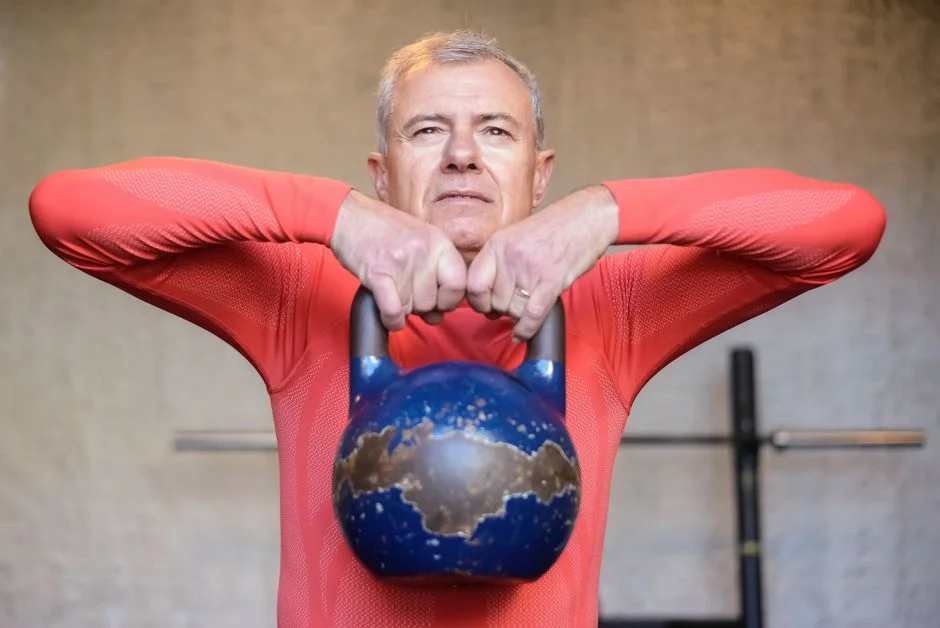
If your joints complain when you lift after 50, change the tool before you change the goal. A 53-year-old trainer interviewed by Men’s Health says he still trains four or five days a week and stays strong by swapping exercises, using machines and cables, pushing a sled, and walking every day. His four adjustments are practical, and we can check two of them against research.
The four adjustments
1. Use machines and cables for some of the work. Bryan Krahn, who created the Men’s Health “Max Muscle at 50” program, says barbells and dumbbells started to hurt his joints about a decade ago. He took some time off, moved to machines and cables, and says that within four or five months he had no pain and was strong again. Machines guide the movement along a fixed path, so you can put effort into the muscle instead of balancing the weight. The magazine’s fitness director suggests one machine move near the end of a session, such as a cable row or leg press.
2. Do not marry an exercise. Krahn swapped skull crushers for triceps pressdowns and supinated dumbbell curls for hammer curls, and still built the muscle. His rule is to try a variation as soon as something feels off, rather than waiting. Strength coach Pat Davidson, quoted in the same piece, makes the same point.
3. Train power with less pounding. Power is how fast your muscles can produce force, which you use when you jump, hop or start to run. Jumping drills can be hard to absorb in your 50s, so Krahn uses sled pushes, often as a warm-up on upper-body days, and suggests two to three sets of 30 seconds. Davidson’s argument is that a forward-leaning push is a safer way to build power than jumping.
4. Walk every day. Even when he has only 15 minutes, Krahn walks. He does not lift daily, but he walks daily.
What the research can back up
The walking advice has the strongest support. A meta-analysis of 15 cohort studies followed 47,471 adults for a median of about seven years. Compared with the least active quarter (median 3,553 steps a day), the hazard ratio for dying from any cause was 0.60 for the next quarter (about 5,800 steps), 0.55 for the third (about 7,800) and 0.47 for the most active (about 10,900). Among adults 60 and older, the benefit leveled off at roughly 6,000 to 8,000 steps a day; under 60, at 8,000 to 10,000.[1]
That study counted steps, not 15-minute walks, and it was observational, so it cannot prove walking caused the lower risk. People who walk more may differ in other ways. It does suggest a daily walk is a sensible floor.
On joint comfort, a Cochrane review of 121 trials of resistance training in older adults found muscle soreness and joint pain were reported in many of the trials that tracked them, while serious problems were rare and not directly linked to the exercise.[2] It did not compare machines with free weights, so the idea that machines are gentler on joints rests on Krahn’s experience and the magazine’s trainers, not on a trial I could verify.
Limits
- This is one trainer’s experience. It worked for him; your joints, injury history and goals may differ.
- The article does not cite studies for machines, exercise swaps or sled pushes. Treat those as reasonable coaching ideas, not proven fixes.
- Pain that lingers, wakes you at night or follows an injury deserves a clinician’s look. Swapping exercises is for ordinary joint grumbling, not a diagnosis.
What to try this week
- Add one machine or cable exercise near the end of a session, such as a seated cable row or leg press.
- If a lift bothers a joint, swap in a variation that does not (pressdowns for skull crushers, hammer curls for supinated curls) and see how it feels over a few sessions.
- Try two to three sets of 30-second sled pushes as a warm-up, with a light load to start.
- Walk every day, even for 15 minutes, and let the habit grow toward 6,000 to 8,000 steps if you are 60 or older.
References
↑︎ Paluch AE, Bajpai S, Bassett DR, et al. Daily steps and all-cause mortality: a meta-analysis of 15 international cohorts. Lancet Public Health. 2022. Finding as used: 47,471 adults, 3,013 deaths, median follow-up 7.1 years; adjusted HR for all-cause mortality 0.60, 0.55 and 0.47 for quartiles 2 to 4 versus quartile 1; benefit plateaued at 6,000 to 8,000 steps/day in adults 60 and older and 8,000 to 10,000 in younger adults. DOI: https://doi.org/10.1016/S2468-2667(21)00302-9
↑︎ Liu CJ, Latham NK. Progressive resistance strength training for improving physical function in older adults. Cochrane Database Syst Rev. 2009. Finding as used: 121 randomized trials, 6,700 participants; joint pain and muscle soreness reported in many trials that monitored them; serious adverse events rare and none reported as directly related to the exercise programme. DOI: https://doi.org/10.1002/14651858.CD002759.pub2

Kurt Greiner
Kurt is a digital strategist and IT professional blending emerging technology with practical application, exploring how individuals can leverage modern tools to navigate the second half of life with purpose.
Leave a Reply