The muscle loss that determines your quality of life at 80 isn’t the dramatic wasting you picture with nursing homes and walkers. It’s the 1-2% a year you lose starting in your late 30s that you never notice, because it’s quietly replaced by fat at the same body weight [1]. Your weight stays the same. Your clothes fit the same. Your body composition shifts underneath, without you seeing it.
By the time you actually notice functional decline – trouble getting out of a low chair, walking slower, losing your balance on uneven ground – you’ve already lost 20-30% of your peak muscle mass. The Health ABC study measured this directly in older adults and found that muscle loss speeds up after 65, but the path is set decades earlier [1]. The muscle loss that lands people in assisted living at 80 started as a slow, invisible drift in their 40s – which is exactly why there’s still time to change course.
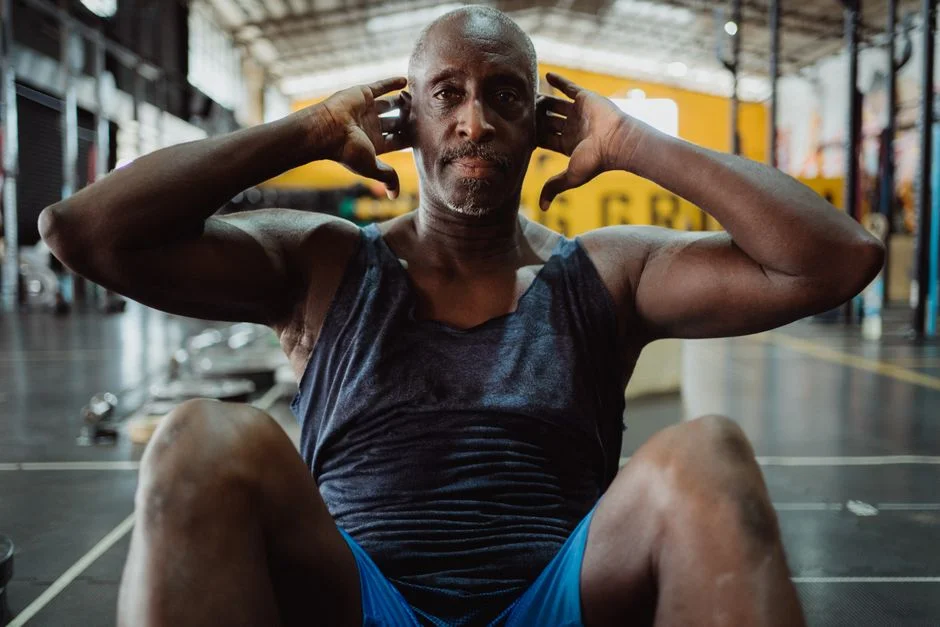
The fix has nothing to do with how you look. The minimum needed to maintain muscle mass at 40 is two full-body resistance sessions a week at 70-80% of your one-rep max (roughly a 7-8 out of 10 in effort – meaning the last two reps of each set are genuinely hard, but not to complete failure) [2]. Below that load, you’re toning, not preserving. Toning changes how you look. Preservation changes what you can still do at 80.
What does “70-80% of your max” actually feel like? Take a squat: if the heaviest weight you can lift once is 100 kg, you want to work with 70-80 kg for sets of 8-12 reps. The last two reps of each set should feel like a 7-8 out of 10 in effort – hard, but not a grind. If you can finish a set and immediately chat comfortably, the weight’s too light. If you need more than three minutes to recover between sets, it’s too heavy. The right zone is predictable: steady effort, adding a bit more weight (2.5-5 kg) every 2-3 weeks as the current weight gets manageable, and full range of motion.
Protein at 1.6 grams per kilogram of body weight a day is the floor for building muscle in midlife [3]. Below that, your body can’t repair the small tears from training, so you stay in a losing state even if you’re lifting consistently. How you spread it out across the day matters too: aiming for 30-40 grams of protein per meal (rather than one huge dinner) produces a longer, steadier muscle-building response than the same total amount packed into one meal. Leucine, the amino acid that triggers muscle building, needs to hit about 2.5-3 grams per meal – roughly what you’d get from 30 grams of whey protein or 120 grams of chicken breast.
Walking more than 8,000 steps a day maintains the coordination and bone density that resistance training alone doesn’t fully cover . Step count isn’t cardio – it’s a signal that tells your skeleton to hold onto its mineral density and your nervous system to keep the reflexes and coordination that prevent falls. Falls are the leading cause of injury-related death in adults over 65, and higher step counts in middle age are linked to a lower risk of falling later.
This isn’t a full plan. It’s the floor. You can’t build a real prevention strategy on less than this – but you also don’t need much more than this to get the real benefit.
Counterpoint: can you still build muscle after 50? Yes – but the effort-to-gain ratio changes. “Anabolic resistance” – a weaker muscle-building response to protein and resistance exercise – increases with age . A 65-year-old needs roughly 40 grams of protein per meal to trigger the same response a 30-year-old gets from 20 grams. The protein needed per meal goes up, recovery takes longer, and gains come slower. The research is clear that older adults can still build muscle with enough protein and load – the ceiling is just lower. Building your reserve in your 40s pays off, because the same amount of building gets more expensive in your 60s.
The three things that get in the way of this plan aren’t knowledge, time, or money. They’re the belief that “something” is as good as “enough,” confusing how you look with what you’re actually preserving, and assuming you’ll notice the loss before it becomes a real problem. When it comes to preserving muscle, “enough” is a specific number – two sessions, 1.6 g/kg of protein, 8,000 steps. Anything below that is just exercise, and it’s worth knowing that clearly rather than feeling bad about it.
Bettering Me’s recommendation: two sessions, 1.6 g/kg, and 8,000 steps. That’s the minimum. Everything else is optional.
A sample week. Monday: resistance training (squat, bench press, row – 3 sets of 8-10 reps each). Wednesday: resistance training (deadlift, overhead press, pull-up or lat pulldown, farmer carry – 3 sets of 8-10 reps each). Every day: 8,000+ steps, built up through walking meetings, parking farther away, after-dinner walks, or a dedicated 20-25 minute walk. Protein: 30-40g per meal across four meals (breakfast, lunch, dinner, evening snack). That’s it. No split routines, no special equipment beyond a barbell or dumbbells and a rack, no periodization plan, no tracking beyond a simple training log. Consistency matters more than precision here.
What failure usually looks like. The most common failure isn’t doing nothing – it’s doing too much and burning out within eight weeks. The second most common is lifting too light. People confuse “tired from exercising” with “actually stressed the muscle enough.” If you finish a resistance session feeling tired but not challenged on the last two reps of each set, the weight is too light. The signal you want for preserving muscle is a real struggle, not just fatigue. If you’re not struggling on those last two reps, you’re not preserving muscle – and that’s a useful thing to notice and fix, not a reason to be hard on yourself.
Disclaimer: This post is for inspiration and education, not medical advice. Everyone’s body is different, so please check with your doctor before changing your diet, exercise, or lifestyle routine. By using these tips, you agree to do so at your own risk.
References
[1] Goodpaster BH, et al. "The loss of skeletal muscle strength, mass, and quality in older adults." *J Gerontol A Biol Sci Med Sci*. 2006;61A(10):1059-1064.. DOI: https://doi.org/10.1093/gerona/61.10.1059
[2] Hughes DC, Ellefsen S, Baar K. "Adaptations to Endurance and Strength Training." *Cold Spring Harb Perspect Med*. 2018;8(6):a029799.. DOI: https://doi.org/10.1101/cshperspect.a029769
[3] Phillips SM, Chevalier S, Leidy HJ. "Protein ‘requirements’ beyond the RDA." *Appl Physiol Nutr Metab*. 2016;41(5):565-572.. DOI: https://doi.org/10.1139/apnm-2015-0550
[4] Burd NA, Gorissen SH, van Loon LJ. "Anabolic resistance of muscle protein synthesis with aging." *Exerc Sport Sci Rev*. 2013;41(3):169-173.. DOI: https://doi.org/10.1097/JES.0b013e318292f3d5

Kurt Greiner
Kurt is a digital strategist and IT professional blending emerging technology with practical application to help businesses and individuals streamline their digital presence. His current work focuses on the intersection of intentional living and technological resilience, exploring how individuals can leverage modern tools to navigate the second half of life with purpose.
Leave a Reply
You must be logged in to post a comment.