
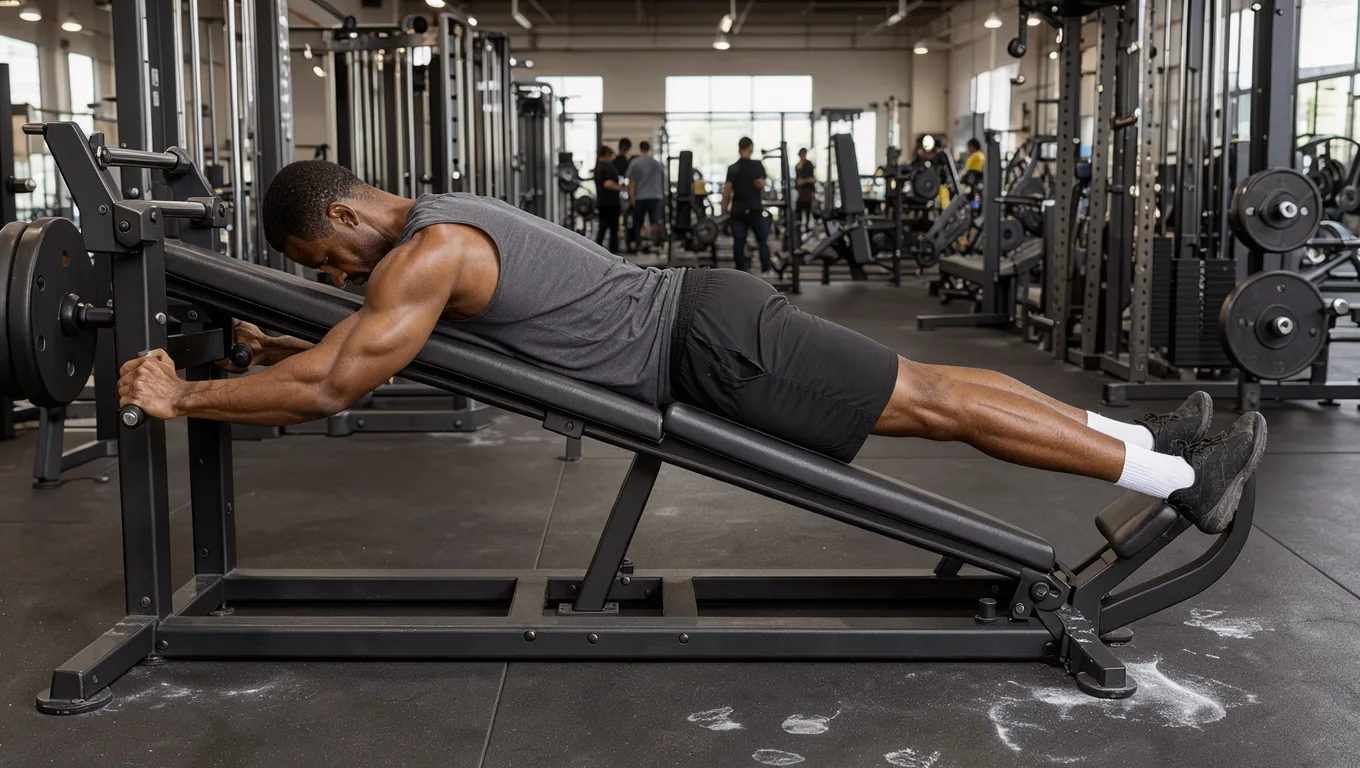
It is easy to skip, because the machine looks like a bench you could never get comfortable on. You lock your ankles under the rollers, rest your knees on the pad, and lower your torso forward under control, then pull yourself back up using your hamstrings. It is hard, and this study found hamstring activity was highest during the glute-ham raise and the Romanian deadlift.
What the study looked at
This post draws on a small lab study by McAllister and colleagues. Twelve healthy, weight-trained men did single repetitions at 85% of their one-repetition maximum on four exercises: the leg curl, the good morning, the glute-ham raise, and the Romanian deadlift. During each lift, the team recorded surface electromyography (EMG) from the hamstrings and several nearby muscles, including the lower back and calf.[1]
What it found
- Hamstring activity was highest during the Romanian deadlift and the glute-ham raise. The authors describe both as maximizing hamstring involvement.
- The semitendinosus, one of the inner hamstring muscles, was more active than the biceps femoris across all four exercises.
- The significant differences between exercises, in both the lowering and lifting phases, showed large effect sizes.
What it cannot tell you
- It measured muscle activity during two trials of a single repetition per exercise. It did not measure muscle growth, strength gains, or results over weeks of training.
- Twelve men is a small group, and all were already weight-trained. The results may not carry over to beginners, women, or older adults.
- Higher EMG activity means the muscle is working harder in that moment. It does not prove the muscle will grow more. The abstract ranks the glute-ham raise and the Romanian deadlift highest for hamstring activity. It does not show that the glute-ham raise builds more hamstring size than a leg curl.
How to use this
This study does not show how the glute-ham raise compares with other hamstring work for building muscle. Its authors suggest focusing on it, along with the Romanian deadlift, to maximize hamstring involvement, so it is a reasonable exercise to consider. If you are new to it, start with a partial range and use your hands on the floor to help you come back up. Control the lowering phase rather than dropping into it. Stop if you feel sharp pain in your lower back. Your own limits and any injury history should set how far you go.
References
[1] McAllister MJ, Hammond KG, Schilling BK, Ferreria LC, Reed JP, Weiss LW. Muscle activation during various hamstring exercises. J Strength Cond Res. 2014;28(6):1573-1580. DOI: 10.1519/JSC.0000000000000302. Finding as used: 12 healthy, weight-trained men performed single repetitions at 85% 1RM of the leg curl, good morning, glute-ham raise and Romanian deadlift while surface EMG was recorded. Hamstring activity was maximized in the RDL and glute-ham raise; the semitendinosus was substantially more active than the biceps femoris across exercises. The study measured muscle activity only, not hypertrophy or strength outcomes. ↑︎

Kurt Greiner
Kurt is a digital strategist and IT professional blending emerging technology with practical application, exploring how individuals can leverage modern tools to navigate the second half of life with purpose.
Leave a Reply