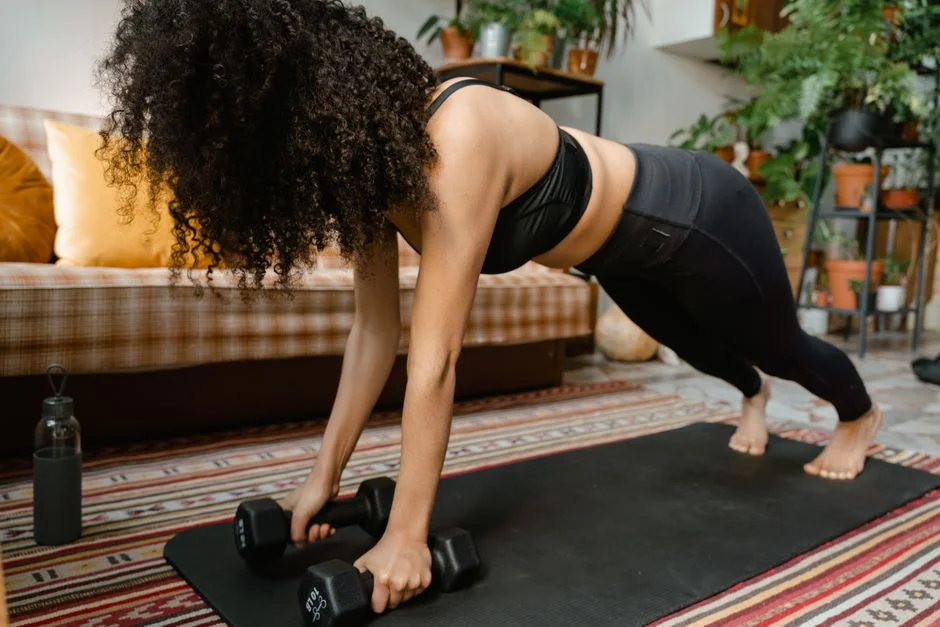
Wall sits and planks are isometric exercises. You hold a position under load and the joint doesn’t move. Plenty of people treat them as filler. The blood pressure research gives them a more serious place in the week, but the evidence is thinner than most headlines make it sound.
What the big review found
In 2023, Edwards and colleagues published a network meta-analysis in the British Journal of Sports Medicine. It pooled 270 randomised controlled trials with 15,827 participants and compared exercise types for resting blood pressure.[1]
Isometric training came out on top. On average it lowered systolic pressure (the top number) by about 8 mm Hg and diastolic pressure (the bottom number) by about 4 mm Hg. Combined training, aerobic exercise, dynamic resistance training and high-intensity intervals all produced smaller systolic drops, roughly 4 to 6 mm Hg.
Two things keep this from being a clean verdict. The gap between isometric and combined training was only about 2 mm Hg. And the ranking comes from indirect comparisons across trials with different populations, protocols and durations, so it works as a signal rather than a head-to-head answer. Those trials were not restricted to people with high blood pressure.
What the 2026 trial added
Swift and colleagues published a randomised trial in BMJ Open Sport & Exercise Medicine in 2026 that asked a different question: how often do you need to do isometric work to keep the effect? The study enrolled 100 adults with normal to high-normal blood pressure.[2]
For the first four weeks, the trial groups did lower-body isometric exercise three times a week. By week four, systolic pressure had dropped by 9.45 mm Hg compared with control. For the next four weeks, participants were assigned to keep training three, two, one or zero times a week.
By week eight, the one-, two- and three-session groups had kept their reductions in systolic and mean arterial pressure. The three-session group came out significantly ahead. The group that stopped returned to control levels. Only the three-session group also held onto the vascular and nervous-system markers the researchers tracked.
Where many summaries go too far
A lot of coverage reads this trial as proof that one or two sessions a week is enough to keep blood pressure down. The paper doesn’t say that. Its abstract says lower frequency can partially slow how quickly the gains fade. The one- and two-session groups kept their reductions, but the three-session group’s result was the one that stood out.
What to do with this
- Isometric holds need no equipment, and a wall sit or a plank is a simple way to start.
- In that trial, the three-session group kept the largest reductions at week eight. It enrolled adults with normal to high-normal pressure, so it does not set a dose for anyone with high blood pressure.
- Across the two studies, systolic drops ran from roughly 4 to 9.5 mm Hg, and the 2026 trial’s drop was 9.45 mm Hg at week 4. Trial lengths varied, and the 2026 trial ran eight weeks. This is not a cure.
- If you have a diagnosis of high blood pressure, take blood pressure medication, or have a heart condition, talk to your clinician before you start. An exercise routine is not a replacement for prescribed care.
The 2023 review is the strongest piece of this picture, and the 2026 trial is a single eight-week study. Read them as a reason to add a few minutes of isometric work to your week, not as a promise about your numbers.
References
- Edwards JJ, et al. Exercise training and resting blood pressure: a large-scale pairwise and network meta-analysis of randomised controlled trials. Br J Sports Med. 2023;57(20):1317-1326. https://doi.org/10.1136/bjsports-2022-106503 ↑︎
- Swift HT, et al. Isometric exercise training and blood pressure control: exploring the dose-response to training frequency in a randomised controlled trial. BMJ Open Sport & Exercise Medicine. 2026;12(3):e003172. https://doi.org/10.1136/bmjsem-2025-003172 ↑︎

Kurt Greiner
Kurt is a digital strategist and IT professional blending emerging technology with practical application, exploring how individuals can leverage modern tools to navigate the second half of life with purpose.
Leave a Reply