
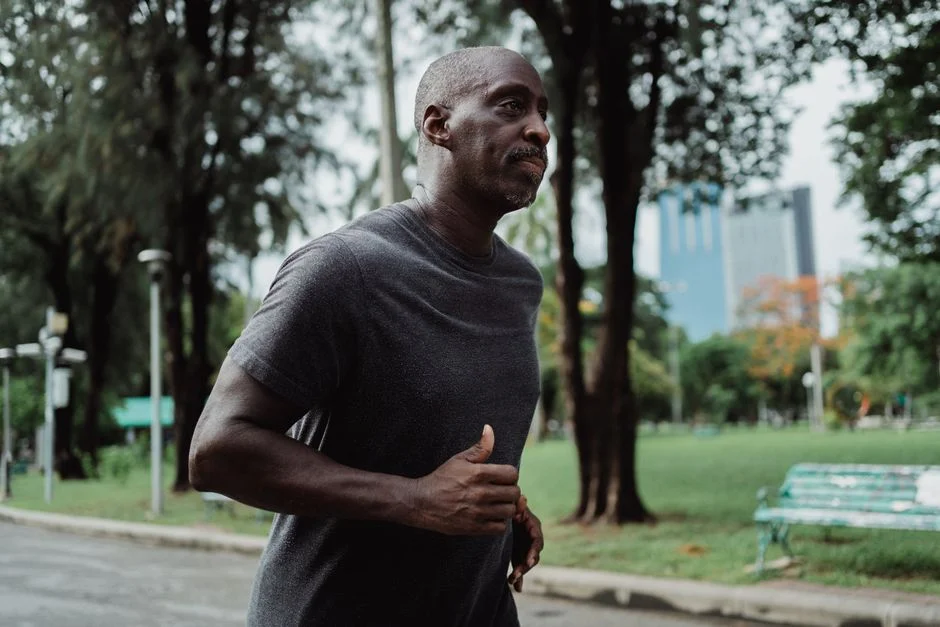
After a big effort, such as a race, a project, or a rough month, you may not need full training volume to hold on to your aerobic base. The research on maintenance points to a simple rule: train less often if you must, but keep the effort real. Here is what the evidence shows, and where it runs out.
The short version: Stopping training costs fitness slowly, not overnight. Two sessions a week at real effort held endurance for up to 15 weeks in one review. It is a floor to stand on while life is busy, not a training plan.
What happens when training stops
Stopping completely does cost something, but the loss is gradual. In a classic 1984 study, seven endurance-trained people stopped training and were retested over 84 days. Their VO2 max (the ceiling on how much oxygen your body can use during hard exercise) fell 7% in the first 21 days and leveled off after about 56 days at 16% below where it started.[1]
Two details matter. After 84 days, they still had a higher VO2 max than eight people who had never trained (50.8 versus 43.3 ml per kg per minute). And the tiny blood vessels feeding their muscles stayed about 50% denser than in the untrained group.[1] It was a very small study, so treat the numbers as a picture of the pattern, not a forecast for you.
A review of the detraining literature adds the timing. When the training stimulus drops for under four weeks, highly trained athletes show a quick decline in VO2 max and blood volume, while the changes are more moderate in recently trained people. Strength declines were limited in that review.[2]
What it takes to hold your fitness
A narrative review of the maintenance research asked a practical question: what is the smallest dose of exercise that preserves what you built? For general populations, endurance performance held for up to 15 weeks when training dropped to as little as two sessions per week, or when session length was cut by 33 to 66%. The condition was that intensity stayed up, meaning the exercising heart rate did not drop.[3]
The same review reported that strength and muscle size held for up to 32 weeks with as little as one strength session per week and one set per exercise, with the load kept heavy enough. In older adults, holding muscle size may take closer to two sessions per week and two to three sets per exercise.[3] The authors’ main conclusion: intensity looks like the key variable, even when frequency and volume fall a lot.
How to use this
- Cut sessions before you cut effort. In the review, two sessions a week was enough to hold endurance for up to 15 weeks in general populations, as long as the effort stayed up.
- Make those sessions count. Keep the effort moderate to hard in each one. A simple check is the talk test: you can speak in short sentences but not hold a conversation. For more on effort, see HIIT vs. Steady Cardio: What a 28-Trial Review Found.
- Shorten, don’t skip. Shorter sessions at the same intensity were enough in the studies the review covered.
- Hold one strength session a week. Use loads that feel challenging for the set. Older adults may need a second session to hold muscle size. See Minimal-Dose Strength Training: What the Review Says.
- Give yourself the recovery you need first. This article is about holding fitness, not about how soon to resume after a hard effort. If you have a heart, joint or blood pressure condition, check with your clinician before adding hard efforts.
What this does not tell you
The maintenance findings come from a narrative review, which pools and interprets studies rather than testing a plan head to head. The review itself notes that data are insufficient for specific recommendations for athletes. The 1984 study followed seven people. None of this predicts how your own fitness will respond, and holding a base is not the same as improving it. Think of it as a floor you can stand on while life is busy, not a training plan.
At Bettering Me, the takeaway we keep coming back to is small and repeatable: protect two effortful sessions a week, and let everything else flex.
References
[1] Coyle EF, Martin WH 3rd, Sinacore DR, Joyner MJ, Hagberg JM, Holloszy JO. Time course of loss of adaptations after stopping prolonged intense endurance training. Journal of Applied Physiology, 1984;57(6):1857-1864. Population: 7 endurance-trained subjects compared with 8 sedentary controls. DOI: https://doi.org/10.1152/jappl.1984.57.6.1857. Finding as used: VO2 max declined 7% in the first 21 days of inactivity and stabilized after 56 days at 16% below the trained value; after 84 days it was still higher than in sedentary controls (50.8 vs 43.3 ml/kg/min); muscle capillarization stayed 50% above sedentary controls. ↑︎
[2] Mujika I, Padilla S. Detraining: loss of training-induced physiological and performance adaptations. Part I: short term insufficient training stimulus. Sports Medicine, 2000;30(2):79-87. Review. DOI: https://doi.org/10.2165/00007256-200030020-00002. Finding as used: short-term detraining (under 4 weeks) in highly trained athletes brings a rapid decline in VO2 max and blood volume, changes are more moderate in recently trained individuals, and strength declines are limited. ↑︎
[3] Spiering BA, Mujika I, Sharp MA, Foulis SA. Maintaining Physical Performance: The Minimal Dose of Exercise Needed to Preserve Endurance and Strength Over Time. Journal of Strength and Conditioning Research, 2021;35(5):1449-1458. Narrative review. DOI: https://doi.org/10.1519/JSC.0000000000003964. Finding as used: in general populations, endurance performance can be maintained for up to 15 weeks with as little as 2 sessions per week or a 33-66% cut in session volume if intensity is maintained; strength and muscle size (at least in younger people) can be maintained for up to 32 weeks with 1 session per week and 1 set per exercise, while older populations may need up to 2 sessions and 2-3 sets per exercise; exercise intensity seems to be the key variable. ↑︎

Kurt Greiner
Kurt is a digital strategist and IT professional blending emerging technology with practical application, exploring how individuals can leverage modern tools to navigate the second half of life with purpose.
Leave a Reply