
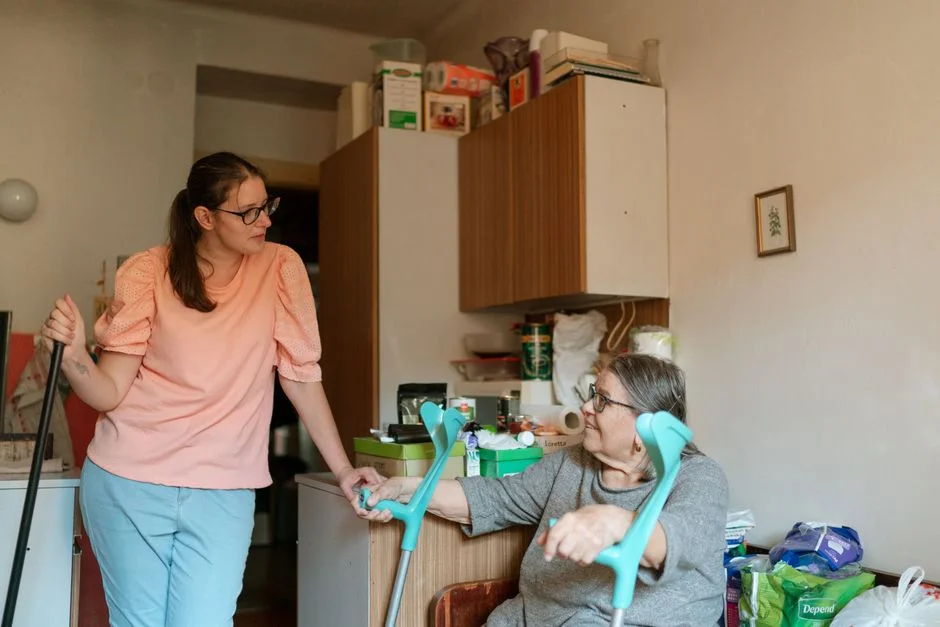
If you care for a parent or partner with Alzheimer’s disease, plan for the role to change. A 2026 systematic review of sociology research from 2004 to 2024 concluded that family caregiving is not a fixed or uniform role. It shifts across the life span, shaped by life transitions, the lives of the people around you and the support systems in place.[1] Planning in stages, and checking your own strain along the way, is the practical response.
Caregiving is a sequence of stages
The review used a life course approach, which looks at when caregiving happens in a person’s life and how it meets other transitions, rather than treating it as one block of time. The authors call for support that fits caregivers at different life stages.[1]
In practice, the job you take on in the first year after a diagnosis is rarely the job you are doing years later. Your own life keeps moving too: work, children, retirement, your own health.
Strain matters more than the role itself
Caregiving is often described as bad for your health, but the evidence is mixed. A 1999 study followed 819 adults aged 66 to 96 who lived with a spouse. Caregivers who reported mental or emotional strain had about a 63% higher risk of dying over four years than non-caregivers, though the range around that estimate was wide (1.00 to 2.65). Caregivers who did not report strain had no higher risk.[2]
A larger 2013 study matched 3,503 family caregivers with similar non-caregivers and followed them for about six years. Caregivers had an 18% lower death rate (hazard ratio 0.82), and no subgroup, including people who reported strain, had a higher rate.[3]
Neither study was limited to people caring for someone with Alzheimer’s: the first looked at older spouses of disabled partners, the second at family caregivers of people with a chronic illness or disability. Both are observational, so they show associations, not cause. Taken together, they suggest caring for someone is not a health sentence in itself, and that strain that goes unmanaged is the part worth watching.
How to plan for the long haul
- Map the next stage, not the whole road. Ask the care team what the next six to twelve months are likely to bring and what help that stage needs.
- Write down who else is in the picture: siblings, friends, paid help, local services. Decide now who covers what when you are sick or away.
- Check your own strain on a schedule. One monthly question works: is this wearing me down more than last month?
- Tell your own doctor you are a caregiver, so your health gets attention too.
- Arrange breaks before you need them. Respite care is easier to set up early than in a crisis.
References
[1] Bosco N, Cappellato V, Micalizzi E. Negotiating care over time: a systematic review of Alzheimer’s disease caregiving through a life course approach. Sociology of Health & Illness, 2026;48(8):e70280. Population: systematic review of sociological research on family caregiving for people with Alzheimer’s disease published 2004-2024. DOI: https://doi.org/10.1111/1467-9566.70280. Finding as used: caregiving is not a static or homogeneous role but evolves across the life span, shaped by transitions, linked lives and structural conditions; the authors call for policies that are temporally sensitive, culturally reflexive and capable of supporting caregivers across different life stages. ↑︎
[2] Schulz R, Beach SR. Caregiving as a risk factor for mortality: the Caregiver Health Effects Study. JAMA, 1999;282(23):2215-2219. Population: 392 caregivers and 427 noncaregivers aged 66-96 living with their spouses, four US communities, average 4.5 years of follow-up. DOI: https://doi.org/10.1001/jama.282.23.2215. Finding as used: caregivers experiencing strain had 63% higher adjusted 4-year mortality than noncaregiving controls (RR 1.63, 95% CI 1.00-2.65); caregivers without strain (RR 1.08, 95% CI 0.61-1.90) did not have elevated mortality. ↑︎
[3] Roth DL, Haley WE, Hovater M, Perkins M, et al. Family caregiving and all-cause mortality: findings from a population-based propensity-matched analysis. American Journal of Epidemiology, 2013;178(10):1571-1578. Population: 3,503 family caregivers in the REGARDS study matched to 3,503 noncaregivers, average 6-year follow-up. DOI: https://doi.org/10.1093/aje/kwt225. Finding as used: caregivers had an 18% reduced rate of death (hazard ratio 0.823, 95% CI 0.699-0.969); subgroup analyses by race, sex, caregiving relationship and caregiving strain found no subgroup with increased death rates. ↑︎

Kurt Greiner
Kurt is a digital strategist and IT professional blending emerging technology with practical application to help businesses and individuals streamline their digital presence. His current work focuses on the intersection of intentional living and technological resilience, exploring how individuals can leverage modern tools to navigate the second half of life with purpose.
Leave a Reply