
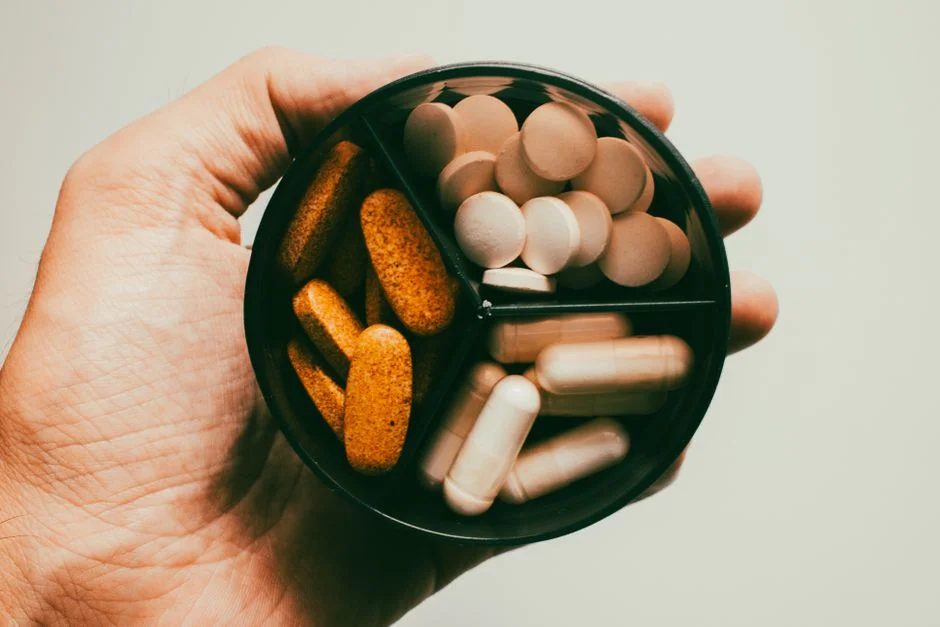
If you or someone you care for takes glucosamine and has a diagnosis of dementia or mild cognitive impairment, put it on the list for the next doctor’s appointment. Don’t make changes on your own. A new study linked glucosamine use to worse outcomes in people who already have dementia or mild cognitive impairment, but it doesn’t show that glucosamine causes dementia, and earlier research in people without dementia found the opposite association. Here’s what the study found and what it can’t tell you.
What the study did
The paper, published in Nature Metabolism in 2026, is mostly lab science with a health-records analysis attached.[1] It focuses on glycosylation: the process cells use to attach sugar chains, called glycans, to proteins. Those chains affect how proteins fold and work. The researchers found higher levels of this sugar tagging (hyperglycosylation) in the brains of mice bred to develop Alzheimer’s-like disease and in donated brain tissue from people who had Alzheimer’s.
Glucosamine is one of the raw materials the body uses to build those sugar chains. So the team tested it in two ways: by giving it to mice, and by looking back through electronic health records from University of Florida Health between 2012 and 2024. That records analysis included 24,481 people with Alzheimer’s disease or a related dementia and 41,884 people with mild cognitive impairment (MCI), a stage of memory or thinking problems that doesn’t yet meet the threshold for dementia. About 8% of patients in each group had glucosamine use noted in their records.[1]
What it found
- People with dementia. Glucosamine use was associated with a 25% higher risk of death over a 10-year survival analysis, after adjusting for age, sex and demographics.
- People with MCI. Glucosamine use wasn’t linked to a significant difference in survival. The share of glucosamine users who moved from MCI to a dementia diagnosis was 25% higher than among non-users.
- Mice with Alzheimer’s-like disease. Oral glucosamine worsened memory, while genetically lowering a glycan-building enzyme improved it.
- Healthy mice. Two weeks of glucosamine didn’t raise sugar tagging in the brain or impair memory.
The authors’ interpretation is that a brain already affected by dementia handles glucosamine differently from a healthy one. They call for a double-blind clinical trial to test the effect of glucosamine on cognitive decline in people with dementia.[1]
Why this isn’t proof
- The human data is an association. Looking back at health records can show that two things travel together, not that one causes the other. People who take glucosamine may differ from people who don’t in ways the records don’t capture, such as joint problems, activity levels or overall health.
- Exposure was pulled from notes. The team identified glucosamine users by keyword matching in clinical notes. That method can’t confirm dose, brand, or exactly how long someone took it.
- Mouse results often don’t carry over to people. The animal experiments help explain a possible mechanism. They don’t tell us what a typical supplement dose does in a human brain.
- Other studies point the other way in healthy adults. A UK Biobank study of 495,942 adults without dementia at the start found that habitual glucosamine use was associated with a 13% lower risk of developing dementia over a median of 11 years (hazard ratio 0.87).[2] That study is also observational, so it doesn’t prove a benefit either.
The two findings don’t necessarily conflict. One looked at people without dementia; the other looked at people who already had it. The new paper’s own mouse work suggests the effect may depend on which of those groups you’re in. Only a proper trial can settle it.
What to do with this
- Bring your full supplement list to every appointment. Include anything over the counter, with doses. Snapping a photo of each bottle label takes two minutes.
- If there’s a dementia or MCI diagnosis in the picture, ask directly. Something like: “I take glucosamine for my joints. Given this new research, should I keep taking it?” Your clinician can weigh it against why you take it and what else you use.
- Caregivers: check what’s in the cabinet. Supplements are easy to overlook when someone else manages the medications. A quick inventory helps the care team see the whole picture.
- If you don’t have a cognitive diagnosis, there’s no new reason to panic. This study wasn’t designed to answer whether glucosamine affects a healthy brain. Talk to your clinician if you have questions about any supplement you take.
One study rarely changes the whole story, and this one is careful to say it’s a starting point. The useful move is a simple one: make sure the people managing your health, or a loved one’s, know every pill in the routine.
References
[1] Hawkinson TR, Liu Z, Ribas RA, Medina T, et al. Hyperglycosylation is a metabolic driver of Alzheimer’s disease. Nature Metabolism, 2026;8(6):1410-1425. Population: transgenic Alzheimer’s mouse models (5xFAD, PS19), wild-type mice, post-mortem human brain tissue, and a retrospective University of Florida Health electronic health record cohort (2012-2024) of 24,481 patients with Alzheimer’s disease and related dementias and 41,884 patients with mild cognitive impairment. DOI: https://doi.org/10.1038/s42255-026-01538-4. Finding as used: brain hyperglycosylation in Alzheimer’s mouse models and human Alzheimer’s tissue; about 8% of patients in each diagnostic group had documented glucosamine use (1,896 with dementia, 2,750 with MCI); glucosamine use associated with a 25% increase in mortality risk among dementia patients (P = 0.0023) in a 10-year survival analysis adjusted for age, sex and demographics; no significant mortality difference in the MCI cohort; a 25% increase in the proportion of MCI patients transitioning to dementia among glucosamine users; glucosamine users identified by keyword matching in clinical notes; oral glucosamine impaired cognition in Alzheimer’s mice while knockdown of glycan biosynthetic enzymes improved it; 2 weeks of glucosamine did not cause hyperglycosylation or impair social memory in wild-type mice; authors call for a double-blind clinical trial. ↑︎
[2] Xu C, Hou Y, Fang X, Yang H, Cao Z. The role of type 2 diabetes in the association between habitual glucosamine use and dementia: a prospective cohort study. Alzheimer’s Research & Therapy, 2022;14(1):184. Population: 495,942 UK Biobank participants without dementia at baseline (2006-2010), median follow-up 11 years. DOI: https://doi.org/10.1186/s13195-022-01137-x. Finding as used: 18.80% reported habitual glucosamine use; 6,831 dementia events; in fully adjusted models, habitual glucosamine use was associated with a significantly lower risk of dementia (HR 0.87, 95% CI 0.82-0.93). ↑︎

Kurt Greiner
Kurt is a digital strategist and IT professional blending emerging technology with practical application to help businesses and individuals streamline their digital presence. His current work focuses on the intersection of intentional living and technological resilience, exploring how individuals can leverage modern tools to navigate the second half of life with purpose.
Leave a Reply