
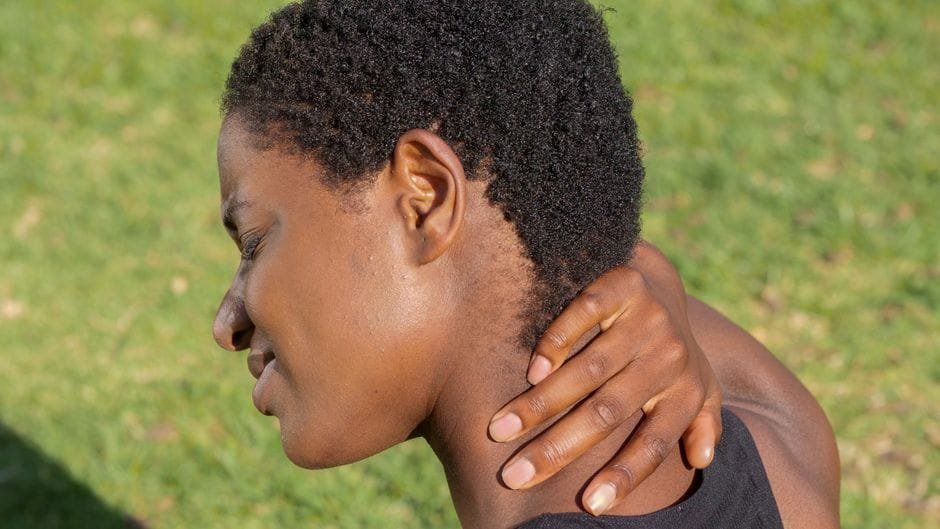
Start with four checks: is your style pulling, is there flaking or a bump, is the pain in one spot, and did a new headache or jaw pain come with it? A sore scalp is easy to brush off until it happens every day: a tender spot when you brush your hair, a burning feeling under a ponytail. Several different problems can cause it, and knowing the common ones helps you decide when to get it checked.
Sensitive scalp and trichodynia: when your hair hurts
A sensitive scalp can bring itching, burning, pricking, or pain, often with redness.[1] If your hair or hair follicles hurt, that scalp pain has its own name, trichodynia. It is most often seen alongside hair loss, including androgenetic alopecia, alopecia areata, and scarring alopecias. Doctors diagnose it by ruling out other causes.[2]
Tight hairstyles
Repeated pulling from tight buns, ponytails, weaves, extensions, or braids can cause traction alopecia, a form of hair loss. A review reports it affects about one-third of women of African descent who wear such styles for a long time. Risk rises with the amount of pulling, how long it lasts, and chemical relaxers. If tight styling continues, the hair loss can progress to permanent scarring.[3] If your scalp is sore under a tight style, loosening or changing it is a reasonable first step, and a dermatologist can tell you whether hair loss has started.
Dandruff and seborrheic dermatitis
Dandruff causes scaling and itching without visible inflammation. Seborrheic dermatitis is the more severe form, with red, scaly, inflamed patches. Both are common, long-lasting scalp conditions linked to Malassezia yeast.[4]
Nerve pain
Occipital neuralgia is severe, sudden pain along the occipital nerves at the back of the head. A review of 579 patients found the pain was usually on one side (81%) and often stabbing (59%). Many patients also had migraine (46%) or a history of neck trauma (30%).[5]
Pain in one spot
A single sore spot is worth noting. Tinea capitis and folliculitis are two common scalp conditions that dermatologists diagnose and manage.[6] Pain alone cannot tell you which problem you have, so a spot that stays tender, flakes, or comes with a bump is worth showing someone.
Shingles
Shingles (herpes zoster) usually causes a painful rash on one side of the body, and it can begin days earlier as a tingling or painful feeling in an area of skin.[8] If you think you might have shingles, get advice from a pharmacist or doctor as soon as possible: antiviral medicine works best when started within 3 days of the rash appearing, and a rash on the eye or nose needs urgent advice.[8]
Head lice and product reactions
Head lice can make the scalp itch and feel sore, and scalp infestations are among the conditions dermatologists manage.[6] A reaction to hair dye or another hair product can also cause burning or tenderness; if the pain started after a new product, stop using it and ask a clinician if it does not settle.
When to see someone
Pain that lasts, comes with a rash, flaking, bumps, or hair loss, or feels sharp and stabbing is worth a visit with a dermatologist or your doctor. Scalp pain has many causes, and a symptom list alone cannot tell you which one you have.
A new tender scalp together with a new headache, jaw pain when chewing, or vision changes is a reason to get same-day medical attention, even if you are not sure what is causing it. Giant cell arteritis is the most common vasculitis among older adults in Europe and North America.[7] It primarily affects people over 50.[9] It usually presents with headache, scalp tenderness, visual symptoms, and jaw or tongue pain with chewing or speaking.[7] Prompt recognition and treatment are crucial.[7] Call your doctor or urgent care today instead of waiting for an appointment. If vision changes are sudden, go to the emergency room.
Sudden, extremely painful headache; headache with a very high temperature and a stiff neck; or headache after a recent head injury: get emergency care (call 911 in the US).[10]
References
↑︎ Souza EN, Anzai A, Fechine COC, Valente NYS, Romiti R. Sensitive scalp and trichodynia: epidemiology, etiopathogenesis, diagnosis, and management. Skin Appendage Disord. 2023;9(6):407-415. DOI: https://doi.org/10.1159/000533795
↑︎ Rodriguez-Tamez G, Imbernon-Moya A, Saceda-Corralo D, Vano-Galvan S. Dermatology update on the challenging trichodynia. Actas Dermosifiliogr. 2025;116(9):T990-T994. DOI: https://doi.org/10.1016/j.ad.2025.07.006
↑︎ Billero V, Miteva M. Traction alopecia: the root of the problem. Clin Cosmet Investig Dermatol. 2018;11:149-159. DOI: https://doi.org/10.2147/CCID.S137296
↑︎ Gupta AK, Landells I, Talukder M, et al. Understanding the scalp: dandruff and seborrheic dermatitis. J Cutan Med Surg. 2025;29(5 suppl):20S-26S. DOI: https://doi.org/10.1177/12034754251368845
↑︎ Melchior AG, Al-Khazali S, Christensen RH, Al-Khazali HM, Ashina H. Epidemiology and clinical features of occipital neuralgia: a systematic review and meta-analysis. Cephalalgia. 2025;45(2):03331024251317595. DOI: https://doi.org/10.1177/03331024251317595
↑︎ Barbosa V, Hight R, Grullon K. Scalp infection, inflammation, and infestation. Dermatol Clin. 2023;41(3):539-545. DOI: https://doi.org/10.1016/j.det.2023.02.008
↑︎ Prieto-Peña D, Castañeda S, Atienza-Mateo B, Blanco R, González-Gay MÁ. A review of the dermatological complications of giant cell arteritis. Clin Cosmet Investig Dermatol. 2021;14:303-312. DOI: https://doi.org/10.2147/CCID.S284795
↑︎ National Health Service (UK). Shingles. URL: https://www.nhs.uk/conditions/shingles/ (accessed 2026-10-14). Finding used: early tingling or painful skin; rash follows after a few days; antivirals work best within 3 days of rash; rash on eye or nose is urgent.
↑︎ MedlinePlus. Giant cell arteritis. National Library of Medicine, reviewed 2025-01-28. URL: https://medlineplus.gov/ency/article/000448.htm. Finding used: “primarily affects individuals over the age of 50”.
↑︎ National Health Service (UK). Headaches. URL: https://www.nhs.uk/conditions/headaches/ (accessed 2026-10-14). Finding used: emergency care for sudden extremely painful headache, headache with high temperature and stiff neck, headache after head injury within 3 months.

Kurt Greiner
Kurt is a digital strategist and IT professional blending emerging technology with practical application to help businesses and individuals streamline their digital presence. His current work focuses on the intersection of intentional living and technological resilience, exploring how individuals can leverage modern tools to navigate the second half of life with purpose.
Leave a Reply