
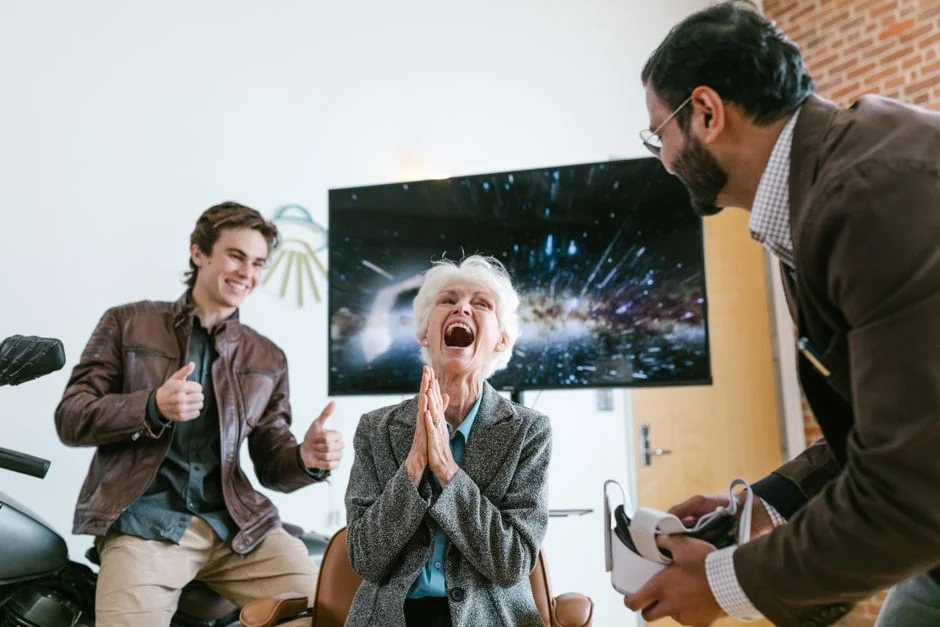
If your parent lives in a nursing home with dementia, a new French trial offers a useful reality check on high-tech fixes. Immersive virtual reality (VR) did not ease behavioral symptoms any better than a plain pen-and-paper group activity. But residents rated their mood higher right after sessions in both groups. The practical takeaway: a regular, well-run group activity is worth showing up for, and you can check whether it helps your parent by asking how they feel before and after.
What the trial tested
The randomized trial ran in 5 nursing homes in the Auvergne-Rhône-Alpes region of France between December 2022 and February 2024. It enrolled 56 residents who had behavioral and psychological symptoms of dementia (BPSD), such as apathy, agitation, anxiety and depression. Fifty-three attended at least one session (27 in the VR group, 26 in the control group), and 50 had complete data for the main symptom analysis. Their average age was 85.7, 79% were women, and 57% had Alzheimer’s disease.[1]
Both groups met in small groups of up to 6 residents, twice a week for 6 weeks, 45 minutes per session, for 12 sessions in all.[1]
- VR group. A staff facilitator introduced the session, residents watched 7 to 12 minutes of 360-degree videos in headsets (landscapes, farms, a city walk, diving with dolphins), then spent about 25 minutes talking about what they had seen.
- Control group. Residents sat at a table with a facilitator and did pen-and-paper activities: word games, quizzes, spot-the-difference puzzles and coloring.
The control group is what makes this trial useful. Earlier VR studies often had no comparison group or compared VR with usual care, so they couldn’t separate the effect of VR from the effect of doing something together. Here, VR went up against another structured activity, known as an active control group.[1]
What it found
- Behavioral symptoms: no difference between groups. Staff-reported scores on the Neuropsychiatric Inventory, a symptom checklist, fell a little in both groups (VR from 27.0 to 22.9, control from 29.4 to 27.0). That drop wasn’t statistically significant, and the difference between the groups wasn’t either (p = .32). Apathy scores didn’t differ between groups.[1]
- Mood right after a session: up in both groups. Residents rated how they felt on a 0 to 5 scale with faces, before and after each session. Scores rose significantly in both groups (p < .001), and VR did not beat the pen-and-paper activity (p = .22).[1]
- Social interaction: possibly more in the low-tech groups, but not statistically significant. Observers counted behaviors such as mutual gaze and nodding. The pen-and-paper groups tended to show more, though the main comparison was borderline (p = .07).[1]
- Safety: no real concerns. Only two research-related adverse events were reported, both in the VR group and both mild symptoms typical of motion sickness.[1]
What this trial can’t tell you
- It’s small. Only 53 residents attended any session, and the authors say the study had limited statistical power. “No significant difference” doesn’t prove VR and the pen-and-paper activity are identical, only that this trial didn’t find a gap.[1]
- It tested one VR product on one schedule. That was a commercial program (Lumeen) on a twice-weekly, six-week plan. It says nothing about other headsets, other content or longer programs. The authors point out that two 45-minute sessions are less than 0.5% of a resident’s week. The VR company supported the trial and helped find nursing homes, and one of its engineers contributed to the design; the authors say it had no role in data collection, analysis or the decision to publish.[1]
- There was no “do nothing” group. Because both groups did something, we can’t say how much of the mood lift came from the activity itself versus extra attention from staff, a change of scene or time of day.
- Attendance was patchy. Only 15 of 53 residents attended all 12 sessions (median 10). The authors cite weather, medical appointments, fatigue and low motivation. Residents who attended more sessions had higher well-being scores, but the authors call that finding exploratory and can’t say attendance caused it.[1]
- It applies to people like those studied. These were nursing home residents with behavioral symptoms, average age about 86. It doesn’t tell you what works for a parent living at home or in an earlier stage. Mini-Mental State Examination scores were missing for 25 of the 53 residents, so the authors couldn’t fully account for how advanced each resident’s dementia was.[1]
What to do with this
- Ask the activities team what group sessions run, how often, and whether your parent goes. VR did not beat the low-tech group activity on any mood or behavior measure in this trial, though a small trial cannot rule out a real difference. The low-tech format is also low-cost: a small group, a trained facilitator, about 45 minutes, a couple of times a week. Ask who leads it and how it’s adapted to your parent’s abilities.
- Borrow the trial’s simplest measure. Before and after a session or a visit, ask your parent “How are you feeling right now?” and jot down a face or a number from 0 to 5. The trial used that question with a faces scale.[1] Two weeks of notes will show you which activities and times of day seem to help. Using it this way at home is our suggestion and hasn’t been tested.
- Help with attendance. Missed sessions were common in the trial. Ask staff which sessions your parent misses and why, and whether timing, transport or appointments can be moved.
- Treat VR as optional. The trial reported only two mild, motion-sickness-type events in the VR group, so no safety concern emerged, but it was too small to establish safety. Letting your parent try it is reasonable if the facility offers it. This evidence gives no reason to prefer it over low-tech group activities or to push for it.
- Raise worsening symptoms with the care team. If agitation, apathy or distress is getting worse, talk with the facility’s clinicians and your parent’s physician. Don’t ask to start, stop or change a medication without that conversation.
You can’t fix dementia on a visit, and this trial isn’t a promise that any activity will change behavior. What it does show is that both kinds of group session were followed by higher mood ratings, and that ordinary, regular group time is something you can ask about, support and track this week.
References
[1] Giroux M, Delphin-Combe F, Rion M, Temedda MN, Dauphinot V, Tripoz-Dit-Masson S, Grange C, Garnier-Crussard A, Dautricourt S. Effectiveness of a Virtual Reality Immersion Process as a Nonpharmacological Intervention for Behavioral and Psychological Symptoms of Dementia and Immediate Well-Being in People Living in Nursing Homes: Randomized Controlled Trial. JMIR Form Res, 2026;10:e95542. Population: 53 nursing home residents with BPSD who attended at least one session (27 VR, 26 active control; 50 in the primary NPI analysis; mean age 85.7, 79.3% women, 56.6% Alzheimer disease) in 5 French nursing homes; 12 group sessions of 45 minutes over 6 weeks; ClinicalTrials.gov NCT04769024. DOI: https://doi.org/10.2196/95542. Finding as used: no significant between-group difference in BPSD on the Neuropsychiatric Inventory (group-by-time interaction p = .32; NPI means VR 27 to 22.9, control 29.4 to 27.0) or in apathy; immediate well-being (0-5 scale) increased from before to after sessions in both groups (p < .001) with no significant group difference (p = .22); social interactions tended to be lower in the VR group (p = .07); only 2 mild research-related adverse events (motion-sickness symptoms), both in the VR group; 15 of 53 residents attended all 12 sessions (median 10); greater attendance was associated with higher well-being (exploratory); MMSE missing for 25 of 53 residents; the authors report limited statistical power and that VR did not show superiority over active cognitive stimulation; the trial was supported by Lumeen, which had no role in data collection, analysis, interpretation, writing or the decision to publish. ↑︎

Kurt Greiner
Kurt is a digital strategist and IT professional blending emerging technology with practical application to help businesses and individuals streamline their digital presence. His current work focuses on the intersection of intentional living and technological resilience, exploring how individuals can leverage modern tools to navigate the second half of life with purpose.
Leave a Reply