
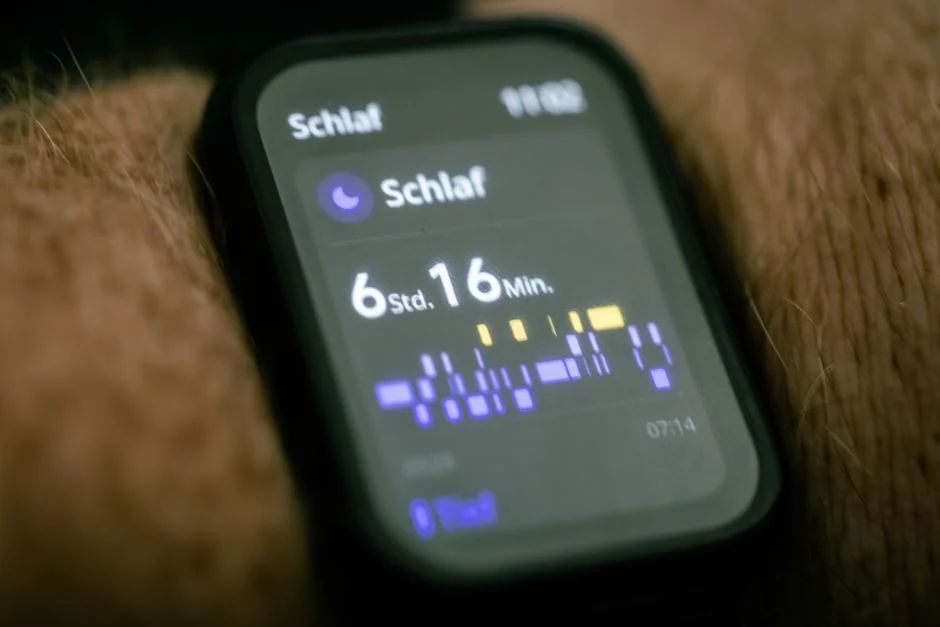
A sleep tracker is meant to help you sleep better. For some people, the numbers become the problem. Clinicians have a name for it: orthosomnia, a preoccupation with perfect sleep that is driven by sleep-tracking data.[1]
Where the term came from
It came from a 2017 case series of three patients, all referred for cognitive behavioral therapy for insomnia (CBT-I). Each had concluded from tracker data that their sleep was poor. The authors described a “perfectionistic quest” for ideal sleep that the tracker seemed to drive. Their suggestion was to work the tracker into cognitive behavioral therapy for insomnia (CBT-I) rather than dismiss it.[1]
A case series describes patients who came to a clinic. It cannot say how common the problem is in the general population.
How common is it? The numbers depend on how you measure
A one-time survey (cross-sectional) of 523 adults flagged orthosomnia with a four-part rule: tracker ownership, insomnia symptoms, low anxiety and high worry about sleep. About 36% of the sample used a tracker. As shares of all 523 adults, the flagged rates were 3.0% under the strictest thresholds, 8.6% under moderate ones and 14.0% under the loosest.[2]
A 2026 national survey, presented as a conference abstract and funded by a ring manufacturer, used a different screen: a two-item anxiety measure adapted for sleep tracking. About 32% of adults reported tracking their sleep. Of those trackers, 31% scored at risk on that measure.[3]
The two figures use different denominators and different tools, so they do not line up. Researchers don’t yet agree on how to measure orthosomnia. Depending on the tool, the estimate runs from a few percent to about a third of trackers, and the upper figure comes from the industry-funded abstract.
Does a tracker make insomnia worse?
One small study found no sign of harm, at least in the short term. In a four-week study, 14 adults with insomnia wore a wrist tracker while 12 others kept a paper sleep diary. Sleep quality, sleep reactivity to stress and quality of life improved for everyone, and the tracker group did not differ from the diary group.[4] That is 26 people over four weeks, and we read only the abstract.
A 2026 preprint of 1,050 adults found that tracker users reported more sleep anxiety than non-users only if they also scored high on perfectionism. Among people with low perfectionism, there was no difference.[5] It is a preprint, and we read only the abstract. A survey like this cannot show that the tracker caused the anxiety, only that the two travel together in people who are already perfectionistic.
What to do with this
None of these studies tests a fix, so treat these as things to notice rather than rules.
- Notice whether a bad night on the tracker changes how you feel the next day, or only how you feel about the tracker.
- Notice whether you check the score before you check how you feel.
- If you tend toward perfectionism, notice how you react to a score that falls short. In one preprint, that group reported more sleep anxiety.
If poor sleep lasts for weeks or affects your days, talk with a clinician. Insomnia has treatments, including CBT-I, and a clinician can help decide how a tracker fits in.
References
[1] Baron KG, Abbott S, Jao N, Manalo N, Mullen R. Orthosomnia: Are some patients taking the quantified self too far? Journal of Clinical Sleep Medicine. 2017. DOI: 10.5664/jcsm.6472. Finding: a case series in which patients sought treatment for self-diagnosed insomnia from sleep-tracker data; the authors coined “orthosomnia” for perfectionistic preoccupation with sleep data and suggest accommodating trackers in CBT-I. Full text read. ↑︎ a b
[2] Jahrami H, Trabelsi K, Husain W, Ammar A, BaHammam AS, Pandi-Perumal SR, et al. Prevalence of Orthosomnia in a General Population Sample: A Cross-Sectional Study. Brain Sciences. 2024. DOI: 10.3390/brainsci14111123. Finding: 523 participants; 35.8% used trackers; algorithm-flagged orthosomnia 3.0%, 8.6% and 14.0% under conservative, moderate and lenient thresholds. Abstract only. ↑︎
[3] Goel R, Quan SF, Ejikeme C, Weaver MD, Sablan J, Czeisler CA, et al. 0553 Exploring the Prevalence of Sleep Tracking and Orthosomnia in a National Survey of Adults in the US. SLEEP (conference abstract), 2026. DOI: 10.1093/sleep/zsag091.0552. Finding: national panel, n=1,280; 32.4% track sleep; 30.9% of trackers screened at risk on an adapted two-item anxiety measure. Abstract only. Funded by a ring manufacturer, as stated in the abstract. ↑︎
[4] Ojalvo D, Pacheco AP, Benedict C. A useful tool or a new challenge? Hand-wrist-worn sleep trackers in patients with insomnia. Journal of Sleep Research. 2023. DOI: 10.1111/jsr.13883. Finding: 14 patients wore a Fitbit for four weeks and 12 kept a sleep diary; sleep quality, sleep reactivity to stress and quality of life improved for all, with no significant difference between groups. Abstract only. ↑︎
[5] Green O, Nimrodi S, Kahn M. Sleep Tracker Use and Sleep Anxiety: Are Perfectionism and Seeking Proxies for Internal States Moderating Factors? Preprint, 2026. DOI: 10.2196/preprints.110819. Finding: n=1,050; tracker use associated with sleep anxiety only at high perfectionism levels. Preprint, abstract only. ↑︎
This post draws on one full-text case series from 2017 and four abstracts. Other studies were not included.

Kurt Greiner
Kurt is a digital strategist and IT professional blending emerging technology with practical application, exploring how individuals can leverage modern tools to navigate the second half of life with purpose.
Leave a Reply