
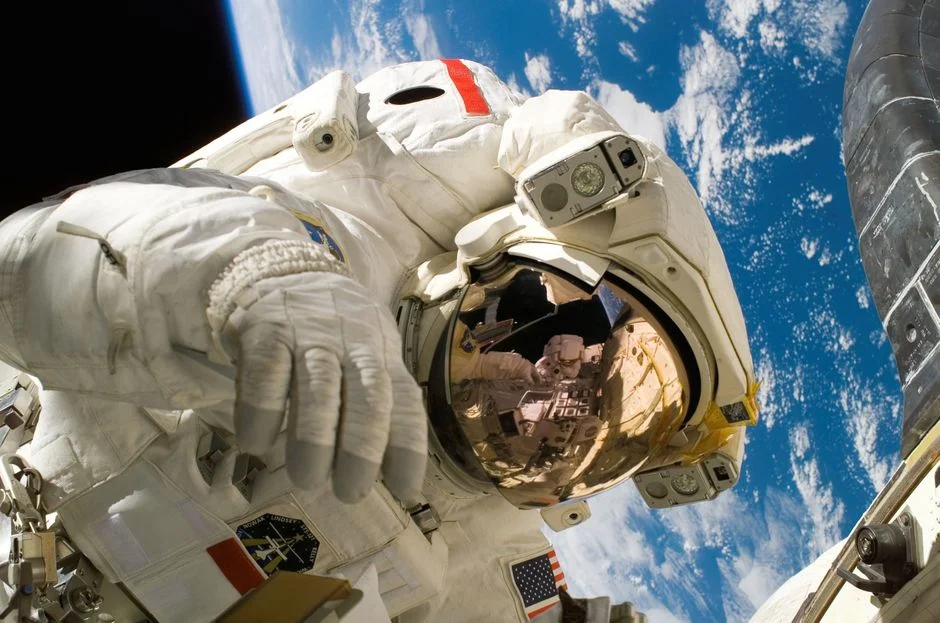
Astronauts offer a rare look at what happens when the body stops carrying load. On long missions, even crews who exercise come home with measurable declines in leg strength and aerobic capacity and a small drop in hip bone density.[1] The study’s authors describe that bone loss as within the precision error of the scan and the overall results as better than on earlier missions, when crews lost 4 to 6% at the femoral neck, so this is not a story of exercise failing. The crews in one NASA study averaged 46 to 48 years old, so the numbers sit closer to your situation than you might expect.
This is not a post about space. It is about what researchers who study spaceflight exercise have learned about protecting muscle and bone, and which of those lessons carry over to a 45-year-old on Earth.
Exercise reduced the losses but did not erase them
In NASA’s Sprint Study, 26 International Space Station crewmembers were assessed before and after long-duration flights. Nine followed a high-intensity, lower-volume program and 17 followed the standard routine. Crewmembers chose their own group, and the standard program itself changed during 2011-2017, which the authors list as limitations. Their average ages were 48 and 46. After flight, both groups showed declines: femoral neck bone mineral density was down 1.7%, knee extensor peak torque was down 5.8%, a cone agility test took 7.4% longer, and peak oxygen uptake (VO2peak) was down 6.1%.[1]
The crews were healthy, screened and mostly men, and microgravity removes the load on the skeleton almost completely. Gravity is not going anywhere on your commute. Still, the pattern is a useful reminder: what you stop loading, you slowly lose, and exercise reduces those losses but does not always erase them.
Heavier resistance went with better bone outcomes
An earlier analysis followed 13 ISS crewmembers on missions from 2006 to 2009. Eight trained with the interim resistive exercise device, which allowed loads of up to about 297 pounds of force. Five used the Advanced Resistive Exercise Device (ARED), which allowed up to about 600 pounds of force.[2]
Only the ARED crews returned with pelvis and hip bone density unchanged from before flight. They also came back with a higher percentage of lean mass and a lower percentage of fat mass. Body mass was unchanged after flight in both groups, and all crewmembers had normal vitamin D status, so neither factor explains why the ARED crews did better.[2]
This was a small, non-randomized comparison, and the two groups also differ by era, since ARED arrived in 2008, so treat it as a hint and not a verdict. The authors’ broader conclusion was that resistance exercise with adequate energy intake and vitamin D can maintain bone during these missions.
Higher intensity with less volume looked similar
Sprint crews still trained six days a week (resistance on three days, aerobic intervals and continuous work on the others) but did less total volume. The groups’ results were not appreciably different in a small, self-selected comparison, which the authors note could miss real differences, with a few measures showing smaller or no losses in the Sprint group. The authors argued that high-intensity, lower-volume training belongs in spaceflight exercise plans because it frees up crew time.[1]
For a busy person, the interesting part is that higher intensity with less total volume did not obviously cost the crews anything. This study did not test how many sessions a week are enough.
What to take from it after 40
None of this is a prescription, and astronaut data does not translate one-to-one to people on Earth. Here are four moves that match what the studies point toward.
- Lift about three days a week with loads heavy enough that the last reps are hard (our wording). Sprint crews did resistance work three days a week, alongside aerobic work on other days, with programs set by NASA trainers. If you are new to heavy lifting, start gradually and consider coaching.
- Eat enough to support your training. Body mass was stable in both device groups, so it does not explain the ARED result, but the authors’ overall conclusion included adequate energy intake.
- Ask your doctor about checking your vitamin D level. Every crewmember had normal vitamin D, including those who lost bone, so it does not explain the difference, but it is a reasonable thing to check.
- Track what you can do, not what you weigh. Strength, agility and aerobic capacity were the measures that moved in flight, and you can measure all three in a gym or a clinic.
If you take one thing, take the first move. Load is the signal your muscle and bone respond to. Before starting heavy lifting, check with a clinician if you have osteoporosis or a past fracture, heart disease, or joint problems. Ask whether a bone-density scan makes sense for you, especially after menopause or if you have risk factors for low bone density.
References
[1] English KL, Downs M, Goetchius E, et al. High intensity training during spaceflight: results from the NASA Sprint Study. npj Microgravity. 2020;6:21. DOI: 10.1038/s41526-020-00111-x. Finding as used: ISS crewmembers did either the Sprint program (n=9, 48 ± 7 y; high-intensity, lower-volume exercise 6 d/wk, with resistance on 3 days and aerobic intervals and continuous work on the others; crewmembers self-selected their group) or the standard daily program (n=17, 46 ± 6 y). After flight, femoral neck BMD fell 1.7%, knee extensor peak torque 5.8%, cone agility time rose 7.4%, and VO2peak fell 6.1% (main effects of time, P<0.05). Outcomes were not appreciably different between programs. ↑︎
[2] Smith SM, Heer MA, Shackelford LC, et al. Benefits for bone from resistance exercise and nutrition in long-duration spaceflight: evidence from biochemistry and densitometry. J Bone Miner Res. 2012;27(9):1896-1906. DOI: 10.1002/jbmr.1647. Finding as used: In 13 ISS crewmembers (8 iRED, 5 ARED), pelvis and hip BMD were unchanged from preflight only for ARED crewmembers, who also returned with higher percent lean mass and lower percent fat mass; body mass was unchanged after flight in both groups and vitamin D status was nominal in all crewmembers. The authors concluded resistance exercise with adequate energy intake and vitamin D can maintain bone in most regions during 4 to 6 month missions. ↑︎

Kurt Greiner
Kurt is a digital strategist and IT professional blending emerging technology with practical application to help businesses and individuals streamline their digital presence. His current work focuses on the intersection of intentional living and technological resilience, exploring how individuals can leverage modern tools to navigate the second half of life with purpose.
Leave a Reply