
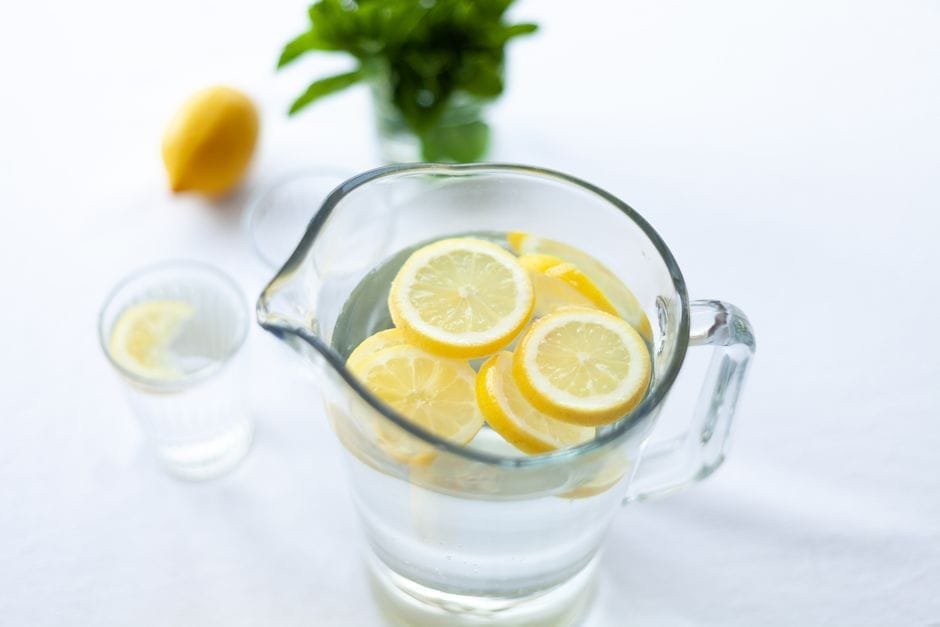
Lemon water shows up in every “morning routine” list online, usually with a promise attached: drink it and the pounds will come off. The research is less dramatic. It does not show that lemon water burns fat, but it does suggest a way the habit could help: it can take the place of a higher-calorie drink.
Swapping drinks is where the benefit comes from
No study cited here tested lemon water as a weight-loss tool. What has been tested is replacing calorie-containing drinks with water. In the CHOICE trial, 318 adults with overweight or obesity replaced at least 200 calories a day of caloric drinks with water or diet drinks, or made diet changes of their own choosing, for six months.[1]
Average weight loss at six months was about 2.0% in the water group and 1.8% in the comparison group, and that difference was not statistically significant. When the two drink-replacement groups were combined, those participants were about twice as likely to lose 5% of their body weight as the comparison group (odds ratio 2.07, 95% confidence interval 1.02 to 4.22).[1] So the swap helped modestly, and it was one of several routes to a similar result.
For scale, the USDA lists regular cola at 42 calories per 100 grams.[2] A 12-ounce can weighs roughly 370 grams, which works out to about 150 calories. A glass of water with a squeeze of lemon has almost none. If lemon makes plain water easier to drink in place of soda, that is a real, if modest, advantage.
What lemon juice does after a meal
One small crossover study used MRI to compare what happens when 10 healthy adults ate 100 grams of bread with 250 mL of water, water-diluted lemon juice, or black tea. Compared with water, lemon juice led to a larger volume of stomach contents 30 minutes after the meal and stomach emptying that was about 1.5 times faster. Blood glucose was lower with lemon juice than with water (35% lower at 55 minutes). Appetite ratings did not differ significantly between the drinks.[3]
That is an interesting finding about digestion and blood sugar after a starchy meal. It is also a study of 10 people eating bread, not a test of weight loss, so it does not show that lemon water helps you lose weight.
What to watch for
Lemon is acidic. In a laboratory study, researchers soaked the enamel of human baby teeth in cola-type drinks and in canned lemon juice. All of the test products damaged the enamel, and the damage grew with longer exposure.[4] That was a test tube setting with canned juice, not diluted lemon water sipped by adults, so it cannot tell us how much risk a daily glass carries. If you drink lemon water often, ask your dentist whether it is a concern for your teeth. And if it gives you heartburn, a weaker mix or skipping it is a simple fix.
The takeaway
Lemon water will not move the scale by itself. Its best case is the same as any good habit: it makes a lower-calorie choice, water over soda, easier to stick with. Pick it if you enjoy it, and judge it by what it replaces.
References
↑︎ Tate DF, Turner-McGrievy G, Lyons E, et al. Replacing caloric beverages with water or diet beverages for weight loss in adults: main results of the Choose Healthy Options Consciously Everyday (CHOICE) randomized clinical trial. Am J Clin Nutr. 2012;95(3):555-563. DOI: https://doi.org/10.3945/ajcn.111.026278
↑︎ U.S. Department of Agriculture, FoodData Central. Beverages, carbonated, cola, regular (SR Legacy, FDC ID 174852). URL: https://fdc.nal.usda.gov/fdc-app.html#/food-details/174852/nutrients
↑︎ Freitas D, Boué F, Benallaoua M, et al. Glycemic response, satiety, gastric secretions and emptying after bread consumption with water, tea or lemon juice: a randomized crossover intervention using MRI. Eur J Nutr. 2022;61(3):1621-1636. DOI: https://doi.org/10.1007/s00394-021-02762-2
↑︎ Grando LJ, Tames DR, Cardoso AC, Gabilan NH. In vitro study of enamel erosion caused by soft drinks and lemon juice in deciduous teeth analysed by stereomicroscopy and scanning electron microscopy. Caries Res. 1996;30(5):373-378. DOI: https://doi.org/10.1159/000262345

Kurt Greiner
Kurt is a digital strategist and IT professional blending emerging technology with practical application to help businesses and individuals streamline their digital presence. His current work focuses on the intersection of intentional living and technological resilience, exploring how individuals can leverage modern tools to navigate the second half of life with purpose.
Leave a Reply