
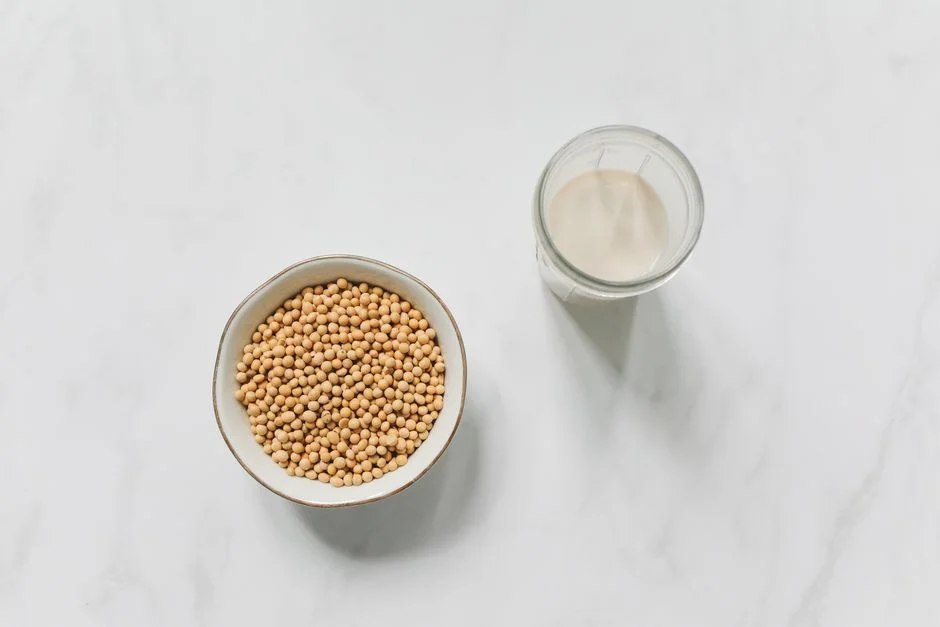
Can a soymilk with added plant sterols and soluble fiber lower LDL cholesterol more than ordinary soymilk? A randomized trial in Thailand tested exactly that. Over eight weeks, the enriched drink produced an additional drop of about 5.5 mg/dL in LDL cholesterol compared with plain soymilk (adjusted; 95% CI 0.6 to 10.4). The effect was modest, and it comes from a single study.[1]
How the trial was set up
The trial ran at two hospitals in Thailand, and chance decided who got which drink. Neither the participants nor the researchers knew which drink was which. It enrolled 242 adults aged 18 or older with LDL cholesterol above 130 mg/dL. Participants were assigned to plain soymilk (119 people) or to soymilk enriched with plant sterols and soluble fiber (123 people). Each group drank two 180 mL packs a day for eight weeks. Most participants were women (194 women and 48 men), with a mean age of 42.3 years. Of the 242, 239 completed the full eight weeks, and the analysis included everyone who was randomized.[1]
The two products contained the same 5 g of soy protein per pack. The enriched version added 1 g of free plant sterol and 5 g of inulin, a soluble fiber, bringing total fiber to 5.8 g per pack. Plain soymilk had 1.7 g of fiber per pack. On the enriched product, daily intake came to 2 g of plant sterol and 11.6 g of total fiber.[1]
What happened to LDL cholesterol
LDL fell in both groups. On plain soymilk, mean LDL dropped by 11.2 mg/dL from baseline. On the enriched soymilk, it dropped by 16.6 mg/dL. After adjusting for baseline LDL, the enriched product came out 5.5 mg/dL lower than plain soymilk (95% confidence interval 0.6 to 10.4, so the true effect could plausibly sit anywhere in that range; p = 0.028). As percentages, the drops were 6.3% and 9.8%. After adjusting for baseline, the gap between the groups was 3.4 percentage points (95% CI 0.6 to 6.2).[1]
The trial did not compare either soymilk with a placebo or with no drink. Plain soymilk also lowered LDL, so the question it answered was whether the enriched drink does more than an ordinary soymilk. It does, by a small margin.[1]
Other blood fats and blood sugar
HDL cholesterol, triglycerides, the total-to-HDL cholesterol ratio and fasting glucose did not differ significantly between the groups at week 8. Total cholesterol fell more on the enriched soymilk at weeks 2 to 8, but those comparisons were exploratory and not adjusted for multiple testing.[1]
Side effects
This is where the enriched soymilk looked worse. Any adverse event was reported by 37.0% of people on plain soymilk and 46.3% on the enriched version, a difference that was not statistically significant (p = 0.140). Product-related adverse events were 5.9% versus 16.3% (p = 0.010). Two participants on the enriched product stopped because of a rash that the authors judged possibly product-related. No serious adverse events were reported. Most product-related adverse events were mild gastrointestinal symptoms.[1]
Caveats from the trial design and results
Six things keep this result in proportion.[1]
- The effect is small. The sample was sized to detect a difference of 9.5 mg/dL, and the observed 5.5 mg/dL falls short of that. The lower confidence bound is 0.6 mg/dL.[1]
- The comparator was plain soymilk, not placebo. Both arms contained soy protein, so the trial says nothing about soymilk versus no soymilk.[1]
- The primary analysis changed from the protocol. The protocol specified repeated-measures ANOVA. The final analysis used a baseline-adjusted mixed-effects model that was not prespecified. The authors say the week-8 endpoint was unchanged.[1]
- The trial was registered retrospectively in 2015, after it was conducted in 2013 and 2014.[1]
- Diet and activity were self-reported (3-day food records and an activity log). Fiber intake rose much more on the enriched arm, so the trial cannot separate the effect of plant sterols from the effect of extra fiber.[1]
- Only eight weeks were studied, and no cardiovascular events or deaths were measured. No sensory test was done to check blinding, and both products came from one manufacturer.[1]
Funding and product source
The study used product made by the company that makes the enriched soymilk. That company is Dairy Plus Company Limited in Thailand, which also manufactured both study products.[1]
What this does and does not show
This is one trial of 242 adults over eight weeks, and its main result is modest. In this trial, the enriched soymilk lowered LDL cholesterol somewhat more than plain soymilk. This single study does not show the same effect for other products. It does not show that the drink reduces heart disease, and it does not show that plant sterols or fiber work the same way outside this product. Anyone with high LDL cholesterol should review the whole picture with a clinician rather than treating a single drink as the fix.[1]
References
Buranapin S, Tejavanija S, Wongthanee A, Manosroi W. A randomized study comparing plant sterol- and soluble fiber-enriched soymilk with plain soymilk in adults with elevated LDL cholesterol. European Journal of Nutrition. 2026;65(8). Trial registration NCT02459314. Finding as used: adjusted week-8 LDL-C difference of 5.5 mg/dL vs plain soymilk (95% CI 0.6 to 10.4; p = 0.028); product-related adverse events 5.9% (plain) vs 16.3% (enriched), p = 0.010; 242 adults, 8 weeks. https://doi.org/10.1007/s00394-026-04138-w ↑︎ a b c d e f g h i j k l m n o p

Kurt Greiner
Kurt is a digital strategist and IT professional blending emerging technology with practical application, exploring how individuals can leverage modern tools to navigate the second half of life with purpose.
Leave a Reply