
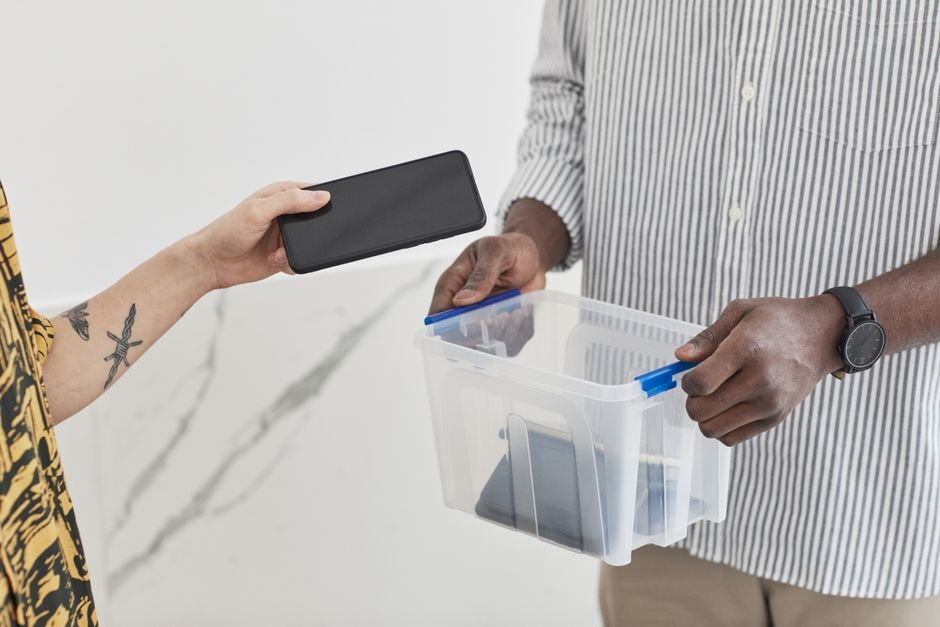
For many people, the phone is the easiest thing to reach for. Today you put it out of reach, then add five minutes of slow breathing to settle in before deep work.
The practice
- Give your phone a basket. A box or drawer just outside your work zone. The phone goes there when the work block starts. It doesn’t need to be a basket. It needs to be outside the zone.
- Downshift with slow breathing. Once a day, before your first task, do five minutes of slow breathing. Take a deep breath in, then a longer breath out, and repeat.
A worked example
Say you’re a designer who checks your phone while files render. The basket sits outside the door. The render takes ten minutes, and you check the phone only when it finishes. Before the next task, you do five minutes of slow breathing at the desk.
Say you’re a sales lead who needs the phone for calls. Keep the phone in the zone, face down, with notifications off during work blocks. The basket doesn’t fit your work, so the boundary moves to the notifications.
Why bother
The phone evidence is contested. A phone on the desk lowered scores on a working-memory test (OSpan) compared with a phone in another room. The effect was small. In the second experiment, the drop appeared only among people with average or high self-rated phone dependence.[1] A direct replication of that second experiment found no difference between phone locations on the same tasks.[2] A separate study found no overall effect. Among people with low smartphone dependency, performance was better when the phone was out of the room.[3] The basket costs nothing, but treat it as a low-cost habit to test, not a proven fix.
The breathing evidence is less contested, but it comes from one trial. In a remote trial, daily five-minute breathing sessions, especially cyclic sighing with its long exhales, improved mood and lowered breathing rate more than mindfulness meditation.[4] Both groups reduced state anxiety, so the trial does not show that breathing beats meditation for anxiety. The practice above is a simplified version of cyclic sighing.
What these studies do and don’t show
The phone studies used students in a lab. None of the samples were remote workers. The breathing trial used five-minute sessions, and measured mood, anxiety and breathing rate. It did not test office workers before deep work, or focus itself. Treat both as a test you run on your own week.
Make it fit your week
Put the basket where you walk past it when you start work. If you share the room, use a drawer or a closed box. Do the breathing once a day, before your first task. Note how the first task goes for a week, and keep what helps.
When it doesn’t work
If you need the phone for work, such as calls or login codes, keep it in the zone, face down, with notifications off. If five minutes is too long, take as many slow breaths as you can. A short reset is still a reset. Missed the basket? Put the phone out of reach at the next break.
Do it today
- Choose a basket spot outside your work zone.
- Put the phone there when your next work block starts.
- Do five minutes of slow breathing once, before your first task.
Time: about six minutes, plus setup.
Check
In your workbook: Where does my phone go during work, and what is my five-minute reset?
Day 5 keeps the basket and ends the day with a shutdown.
References
[1] Ward, A. F., Duke, K., Gneezy, A., & Bos, M. W. (2017). Brain drain: The mere presence of one’s own smartphone reduces available cognitive capacity. Journal of the Association for Consumer Research, 2(2), 140–154. DOI: 10.1086/691462 ↑︎
[2] Ruiz Pardo, A. C., & Minda, J. P. (2022). Reexamining the “brain drain” effect: A replication of Ward et al. (2017). Acta Psychologica. DOI: 10.1016/j.actpsy.2022.103717 ↑︎
[3] Hartmann, M., Martarelli, C., Reber, T. P., & Rothen, N. (2020). Does a smartphone on the desk drain our brain? No evidence of cognitive costs due to smartphone presence in a short-term and prospective memory task. Consciousness and Cognition, 86, 103033. DOI: 10.1016/j.concog.2020.103033 ↑︎
[4] Balban, M. Y., Neri, E., Kogon, M. M., Weed, L., Nouriani, B., Jo, B., Holl, G., Zeitzer, J. M., Spiegel, D., & Huberman, A. D. (2023). Brief structured respiration practices enhance mood and reduce physiological arousal. Cell Reports Medicine, 4, 100895. DOI: 10.1016/j.xcrm.2022.100895 ↑︎

Kurt Greiner
Kurt is a digital strategist and IT professional blending emerging technology with practical application, exploring how individuals can leverage modern tools to navigate the second half of life with purpose.
Leave a Reply