
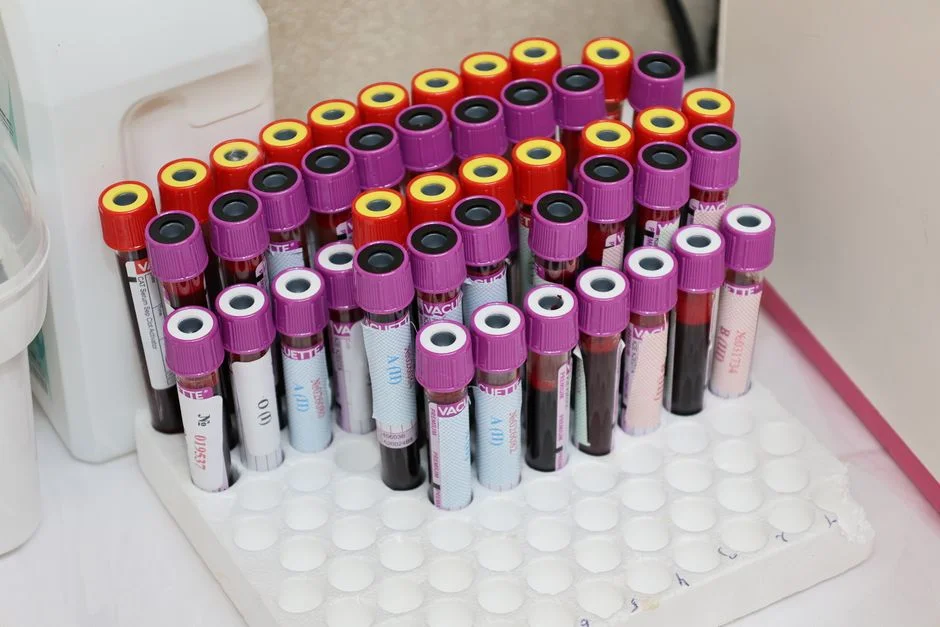
Your routine blood test checks a few dozen markers. A 2026 UK Biobank study measured 2,923 proteins in the blood of 23,776 adults and found that adding them to standard risk factors improved prediction for all 17 diseases it tracked.[1] That does not mean you should chase a protein panel. The study tested prediction, not whether acting on a result improves health, so the useful move today is to get more out of the standard tests you already have.
What the researchers measured
Participants gave blood when they joined the UK Biobank, at an average age of 56.9 (range 39 to 70). The team measured 159 metabolites, the small molecules your body makes as it breaks down food and fuel, and 2,923 proteins, a branch of testing called proteomics. They compared risk models built on standard clinical predictors with models that also used the blood data, and checked how well each predicted diseases diagnosed after the blood draw.[1]
What they found
Adding the blood data improved prediction for all 17 diseases compared with clinical predictors alone. Protein-only models beat metabolite-only models for 16 of the 17 diseases, and combining the two added little beyond proteins alone.[1]
Some top signals were familiar. KLK3, better known as PSA, stood out for prostate cancer. Others were new candidates, such as a protein called PRG3 for skin cancer, which still needs confirming in other groups.[1]
What this study does not show
- Prediction is not prevention. The proteins track with later diagnoses; the study does not show that measuring or changing them prevents disease.
- Blood was drawn once, at enrollment. A single snapshot can’t show how levels shift as a disease develops, a limit the authors name themselves.[1]
- Participants were UK adults aged 39 to 70 at enrollment, so the results may not carry over to other groups.[1]
What to do with your next blood test
- Get a copy of every result and keep them in one place. One value says little; a trend across several years says more.
- Use the same lab when you can, since methods and reference ranges differ from lab to lab.
- Ask your clinician whether markers such as ApoB and hs-CRP make sense for you, given your family history.
- If a company offers you a large protein panel, ask one question first: what decision would the result change? If no one can answer, skip it for now.
References
[1] Du J, Zhou M, Wang H, Wang J, et al. Multi-omics integration predicts the incidence of 17 diseases in the UK Biobank. Nature Communications, 2026;17(1):6271. Population: 23,776 UK Biobank participants with complete baseline data for 159 NMR-based metabolites and 2,923 Olink affinity-based proteins; mean age at enrollment 56.9 years (range 39-70). DOI: https://doi.org/10.1038/s41467-026-73017-z. Finding as used: adding omics data significantly improved risk prediction for all 17 incident diseases compared with clinical predictors alone; proteomics-only models outperformed metabolomics-only models for 16 of 17 diseases; integrating both added little over proteomics alone; key features included KLK3/PSA for prostate cancer and PRG3 as a potential novel marker for skin cancer; omics were collected at baseline only, which the authors list as a limitation. ↑︎

Kurt Greiner
Kurt is a digital strategist and IT professional blending emerging technology with practical application to help businesses and individuals streamline their digital presence. His current work focuses on the intersection of intentional living and technological resilience, exploring how individuals can leverage modern tools to navigate the second half of life with purpose.
Leave a Reply