
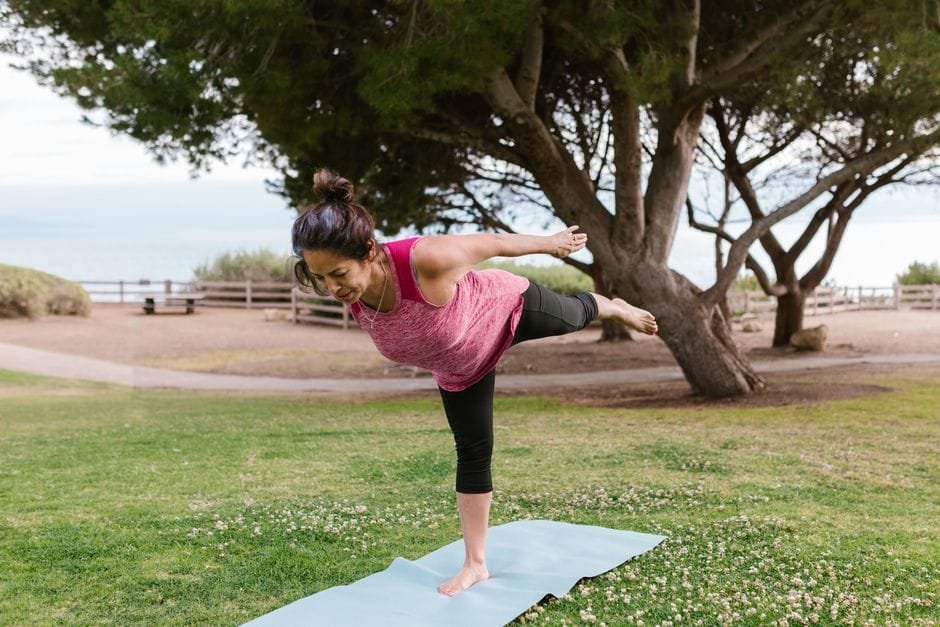
Balance is one of those things nobody notices until it starts slipping, and by then it’s usually because you stumbled over something that shouldn’t have been a big deal. The good news is that simple practice has research behind it.
What keeps you upright
Standing steady relies on information from three sources: the vestibular system of your inner ear, your vision, and proprioception, which is your sense of where your muscles and joints are. A review of postural control reports that signals from the leg muscles are the main source of information for staying upright. It also reports that aging changes those signals, making them less sensitive and less precise.[1]
What the research says about practice
A 2019 Cochrane review of 108 randomized trials (23,407 community-dwelling adults aged 60 and older, average age 76) found that balance and functional exercise programs reduced the rate of falls by 24% compared with control (rate ratio 0.76, 95% CI 0.70 to 0.81; 39 trials, 7,920 people; high-certainty evidence).[2] Programs that combined balance and functional exercises with resistance exercises probably reduced falls by 34%.[2] Most trials had unclear or high risk of bias in at least one area, and the results apply to older adults, not to every age group.[2]
A separate Cochrane review looked at balance itself, using 94 trials with 9,917 older adults. Programs built around gait, balance, coordination, and functional tasks improved scores on the Berg Balance Scale and the Timed Up and Go test. Strengthening programs improved how long people could stand on one leg with their eyes closed. The authors noted that the evidence for each outcome came from only a few trials.[3]
6 exercises worth adding to your week
These six moves use the same ideas as the programs above: balance challenges and everyday leg strength. The specific moves and hold times below are common practice and were not tested one by one in the studies cited here.
- Single-leg stand. Hold onto a counter loosely, lift one foot a few inches off the floor, and hold for 20-30 seconds each side. Progress by letting go of the counter once it’s easy.
- Heel-to-toe walk. Walk in a straight line placing the heel of one foot directly in front of the toes of the other, like a sobriety test. Take ten steps, turn, and repeat.
- Clock reach. Standing on one leg, reach the opposite foot out to different “clock positions” (12, 3, 6, 9) and tap the floor lightly before returning to center.
- Rock the boat. Feet hip-width apart, shift weight slowly from one foot to the other without letting your hips sway side to side. Slower is harder.
- Sit-to-stand without hands. From a sturdy chair, stand up and sit back down without using your arms. This is a leg-strength move.
- Standing marches with eyes closed. Once single-leg stands feel easy, try marching in place with eyes closed for a few seconds at a time, near a wall for safety. Closing your eyes makes the move harder, so hold a sturdy chair and have someone nearby.
Do a few of these most days, near a wall or counter for safety, especially when you’re just starting. If you’ve had a fall recently or have balance problems that feel sudden or severe, call your doctor before you start a new routine. Sudden balance changes can have causes worth ruling out first.
References
↑︎ Henry M, Baudry S. Age-related changes in leg proprioception: implications for postural control. J Neurophysiol. 2019;122(2):525-538. DOI: https://doi.org/10.1152/jn.00067.2019
↑︎ Sherrington C, Fairhall NJ, Wallbank GK, Tiedemann A, Michaleff ZA, Howard K, Clemson L, Hopewell S, Lamb SE. Exercise for preventing falls in older people living in the community. Cochrane Database Syst Rev. 2019;(1):CD012424. DOI: https://doi.org/10.1002/14651858.CD012424.pub2
↑︎ Howe TE, Rochester L, Neil F, Skelton DA, Ballinger C. Exercise for improving balance in older people. Cochrane Database Syst Rev. 2011;(11):CD004963. DOI: https://doi.org/10.1002/14651858.CD004963.pub3

Kurt Greiner
Kurt is a digital strategist and IT professional blending emerging technology with practical application to help businesses and individuals streamline their digital presence. His current work focuses on the intersection of intentional living and technological resilience, exploring how individuals can leverage modern tools to navigate the second half of life with purpose.
Leave a Reply